The plane was still rolling when I saw two sheriff’s cruisers waiting beside the military terminal.
Fourteen hours earlier, I had listened through a phone while men broke into my house and shattered both of my wife’s legs.
Now someone had sent me a photograph taken from outside her hospital room.
WELCOME HOME, SOLDIER.
And somehow they already knew I had landed.
Jonah Reyes leaned across the aisle and followed my stare through the rain-streaked window.
“Could be coincidence.”
Malik Turner snorted from behind him. “Two cruisers at five in the morning after that text?”
Jonah shrugged. “I said could be.”
Owen Shaw studied me instead of the vehicles.
The three men had served with me years earlier. They knew what I looked like when anger stopped being an emotion and became a plan.
“Hospital,” Jonah said.
“Hospital,” I agreed.
That mattered.
Because Brigadier General Marcus Hale had sent me home with one instruction I could still hear clearly.
Not for revenge.
My phone rang before the aircraft door opened.
Unknown number.
“Blake Dean?”
A woman spoke calmly.
“Yes.”
“Special Agent Dana Price, FBI. General Hale contacted us about your wife.”
My attention returned to the cruisers.
“You know where I am?”
“I do.”
“Then you know I have company.”
“I’m looking at them too.”
Across the service road, a woman stood beside a gray SUV.
The aircraft door opened.
Cold rain blew inside.
We descended.
The deputies approached almost immediately, one carrying a folder.
“Blake Dean?”
Dana reached me first and displayed identification.
“What do you need from Mr. Dean?”
The older deputy hesitated.
“We need to speak with him regarding threatening communications.”
“Against whom?”
“Cameron Voss.”
For a second, I genuinely thought I had misheard him.
The man accused of terrorizing my wife was claiming I had threatened him.
Dana’s expression barely changed.
“Do you have a warrant?”
“No.”
“Is Mr. Dean detained?”
“No.”
“Then he’s going to the hospital.”
The deputy handed her a card.
“Sheriff Cole would appreciate his cooperation.”
“Sheriff Cole can call me.”
I walked away without looking back.
That was harder than it sounds.
Every instinct in me wanted confrontation.
Instead, I went to Emily.
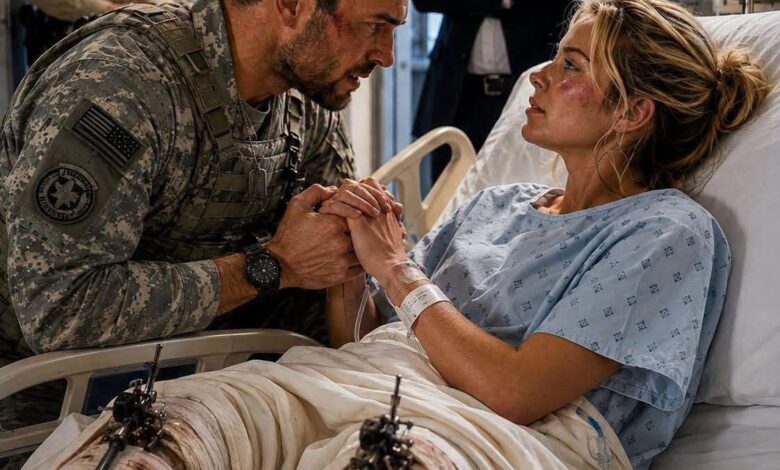
She was sitting upright when I entered her hospital room, both legs immobilized beneath blankets, arguing with a nurse about breakfast.
“This is not oatmeal,” she insisted. “This is wallpaper paste experiencing an identity crisis.”
Then she saw me.
Her face collapsed.
“Blake.”
I crossed the room.
She wrapped her arms around my neck.
For the first time since hearing her scream through the phone, I stopped thinking about Cameron Voss.
I smelled Emily’s shampoo beneath the hospital antiseptic.
Felt her breathing against me.
Alive.
That was enough.
“I’m sorry,” I whispered.
“For what?”
“Not being here.”
She pulled back.
“You were where you were supposed to be.”
My eyes drifted toward her legs.
She noticed.
“The doctors say recovery will take time.”
“I know.”
“And apparently no marathons this month.”
“Unreasonable.”
“I’m filing a complaint.”
I laughed despite myself.
Then her expression softened.
“You’re doing it again.”
“What?”
“The thing where you stop blinking and turn the entire world into a logistics problem.”
“I’m not—”
“You are.”
She touched my cheek.
“I need my husband here, Blake. Not five moves ahead.”
That sentence probably saved me from several mistakes.
An hour later, Dana asked Emily about the weeks before the attack.
That was when I learned Emily had kept something from me.
The young woman she had seen Cameron assault in the parking garage was named Hannah Lee.
Hannah worked in accounting for the Voss Foundation.
After Emily reported the assault, Hannah approached her privately and revealed that she had discovered suspicious payments moving through foundation accounts—consulting fees, security expenses and vendor payments carrying questionable authorization codes.
“You never told me,” I said.
Emily looked down.
“You were deployed.”
“That’s not an answer.”
“Yes, it is.”
Her eyes lifted.
“Because I knew what you’d do. You’d stop sleeping. You’d call everyone. You’d try to solve something from five thousand miles away.”
“I was trying to protect you.”
“I know.”
Her voice softened.
“But sometimes protection becomes deciding what another person can handle.”
That landed harder than anything Dana could have said.
For twelve years, I had hidden difficult parts of myself from Emily. Some because they were classified.
Others because I loved her.
Still others because I simply didn’t know how to talk about them.
I had bundled all three together and called the silence protection.
Emily admitted she had done the same thing.
“We’re apparently both terrible at secrets,” she said.
“Apparently.”
Then she gave Dana six transaction numbers Hannah had asked her to remember.
“Where are the originals?” Dana asked.
“Hannah had them.”
“Where is Hannah?”
Emily’s face tightened.
“She disappeared four days ago.”
The investigation changed quickly after that.
First came the cruiser photographed outside our house.
Its plate was legitimate.
The vehicle wasn’t.
It had been retired from county service months earlier and eventually purchased by Voss Protective Services. Official markings should have been removed.
They hadn’t been.
The “sheriff’s cruiser” watching Emily may never have been a sheriff’s cruiser at all.
Then Dana checked the two vehicles that met my aircraft.
Neither belonged to the sheriff’s department.
Someone had manufactured the appearance of official power.
But the illusion wasn’t entirely fake.
Emily’s emergency calls had somehow been redirected through supervisory channels inside the real sheriff’s department.
Someone on the inside had helped.
The question was who.
The answer began with a company called Blue Ridge Civic Solutions.
Emily found it while reviewing public filings from her hospital bed.
It had received money through programs connected to the Voss Foundation.
A historical filing listed a former manager:
Caleb Wade.
Dana recognized the name.
Captain Caleb Wade.
Sheriff’s department operations commander.
For the first time, we had a documented bridge worth investigating.
Then Sheriff Nathan Cole himself arrived.
He came alone.
I expected arrogance.
Instead, I found an exhausted man carrying the expression of someone discovering how much had happened beneath his own roof.
“My department failed your wife,” he told me.
“Did you know about her calls?”
“No.”
“Do you expect me to believe that?”
“No.”
That answer surprised me.
Cole admitted Richard Voss had donated to campaigns and law-enforcement charities over the years. He acknowledged that small favors and familiar relationships had become normalized.
But when Dana showed him photographs of the cruisers at the airport, Cole went pale.
“I didn’t send those.”
He enlarged one image.
“That unit number belongs to a vehicle totaled last winter.”
The conspiracy I had imagined suddenly became smaller.
Not harmless.
Smaller.
And somehow that made it more understandable.
Cameron Voss did not own an entire police department.
He had something more ordinary.
Connections.
People willing to bend small rules.
People willing not to ask questions.
People who assumed one favor couldn’t matter very much.
That evening, Emily revealed one final secret.
“Hannah gave me a key.”
I closed my eyes.
“You’re allowed to groan,” she said.
“Where is it?”
“In that green vegetarian cookbook your mother gave us.”
“You cut open a book?”
“It was already damaged.”
“You’re a librarian.”
“I contain multitudes.”
Federal agents recovered the key.
Stamped into the brass were three numbers:
317.
A faded plastic tag carried the initials JRS.
James River Storage.
By then, Hannah had been located alive in Charlottesville. She had hidden in a hotel after learning Cameron knew she had copied financial records.
The storage key led investigators to locker 317.
Inside were internal audits, vendor contracts, bank records and correspondence.
There was also a letter from Richard Voss.
And that letter changed everything.
Richard had discovered the financial irregularities after Hannah warned him.
More importantly, he admitted he had spent years shielding Cameron from consequences.
He had explained away his son’s behavior as immaturity, bad influences and temporary instability.
Each explanation bought another delay.
One sentence stayed with me.
I believed protecting Cameron from consequences gave him time to become better. I now understand I may have taught him that consequences belonged to other people.
Richard had secretly copied records because he no longer trusted everyone around his company.
The key was a backup plan.
If he lost his nerve, he wanted Hannah to expose what he couldn’t.
That did not make Richard innocent.
It made him human in a far less satisfying way.
He had not commanded an empire to destroy my wife.
He had simply spent years using money and influence to postpone accepting who his son was becoming.
The investigation narrowed from there.
Grant Wade, Caleb’s brother, had worked in Voss security.
Retired law-enforcement vehicles passed through companies he could access.
Captain Caleb Wade had administrative privileges inside county dispatch.
Emily’s address had been flagged for “supervisory review” despite no legitimate investigation involving her.
Financial trails connected several contractors.
Records showed relationships.
Access logs showed opportunities.
Investigators still had to determine exactly who performed each act.
Dana reminded me repeatedly that evidence mattered more than the story we wanted it to tell.
Real accountability arrived slowly.
Captain Wade was suspended while state and federal investigators examined his conduct.
Grant Wade faced separate allegations.
Sheriff Cole requested outside review of his own department.
Cameron eventually surrendered through counsel.
There was no dramatic confrontation between us.
No parking-garage showdown.
No moment where I proved anything with my fists.
I never spoke to him.
That became one of the decisions I was proudest of.
Emily came home three weeks later.
Jonah, Malik and Owen had installed a temporary accessibility ramp under guidance from her medical team.
Malik added a handrail.
Jonah rearranged the kitchen.
That nearly got him killed.
“You moved my tea,” Emily said.
“So you can reach it.”
“I had a system.”
“Your system was six feet high.”
“It was still my system.”
Malik leaned toward me.
“She’s definitely recovering.”
“I am injured,” Emily snapped, “not deaf.”
Recovery took months.
There were surgeries, appointments, exercises and days when progress seemed to vanish overnight.
Emily hated inspirational slogans.
When a physical therapist suggested she “embrace the journey,” Emily replied, “I’d rather the journey embrace public transportation.”
I learned something too.
I stopped automatically grabbing things from her.
Instead, I asked, “Do you want help?”
Sometimes she said yes.
Sometimes no.
Both answers became equally important.
And slowly, we began repairing something beyond her legs.
I told her when I was afraid.
Not operational secrets.
Not classified details.
Just pieces of myself I had spent years hiding because I thought love meant carrying them alone.
She started doing the same.
Months later, Emily returned to the university library part-time.
Hannah found another accounting position.
Sheriff Cole ordered an outside audit that uncovered broader procedural weaknesses—not evidence that every deputy had been corrupted, but enough failures in oversight to require substantial reforms.
He later announced he would not seek reelection.
Richard Voss stepped away from management of his foundation while independent reviews continued.
Cameron and others faced proceedings based on the evidence investigators could establish. Some matters resolved sooner than others. Others remained contested for months.
Nothing happened with cinematic speed.
Justice rarely does.
Nearly eighteen months after the attack, Emily attended one of the final major hearings.
She walked with a cane.
When offered the opportunity to speak, she stood.
“We live most of our lives trusting people we will never meet,” she said.
“We trust dispatchers to record calls. We trust companies to supervise employees. We trust leaders to ask questions. We trust families to love people without hiding them from responsibility.”
The courtroom was silent.
“What happened to me began before anyone entered my house. It began with small decisions people convinced themselves didn’t matter.”
She paused.
“I don’t want this remembered as a story about one powerful family or one frightened witness.”
Her voice remained steady.
“I want it remembered as proof that small choices matter before the crisis, not only afterward.”
Then she sat beside me.
Outside, reporters shouted questions.
I instinctively reached toward Emily, ready to steer her toward a side exit.
Then I stopped.
Her choice.
“Front or side?” I asked.
She considered.
“Front.”
“Want to talk?”
“No.”
“Then why front?”
Emily took my arm.
“Because it’s the front door.”
So we walked through it.
Reporters shouted Cameron’s name.
Richard’s.
Sheriff Cole’s.
Someone asked whether Emily forgave anyone.
She stopped once.
My body tightened.
Then I remembered.
Not my decision.
Emily turned.
“I’m going home.”
Nothing more.
We kept walking.
The following spring, our house filled with people.
Jonah brought his family.
Malik brought enough food for twenty-seven guests.
Owen arrived late.
Hannah brought dessert.
Emily stood in the kitchen without her cane.
Nobody commented.
That mattered.
She carried a bowl toward the table and caught me watching her.
“What?”
“Nothing.”
“Blake.”
I smiled.
“You look happy.”
Her expression softened.
“I am.”
That night, after everyone left, we sat together on the porch.
Emily rested her feet on a cushion.
“Do you ever think about that phone call?” she asked.
“Yes.”
“Me too.”
For a while we listened to crickets.
“I used to think that night divided everything into before and after,” she said.
“Doesn’t it?”
“Maybe.”
She rested her head against my shoulder.
“But after doesn’t have to mean worse.”
I looked at her.
“What does it mean?”
She smiled.
“After.”
That was Emily.
Once she found the right word, she rarely needed another.
For twelve years, I believed strength meant carrying weight without allowing anyone to see it.
She taught me something harder.
Strength could mean admitting you were carrying something.
Love could mean allowing another person to decide whether they wanted to help.
Protection could mean standing beside someone instead of standing in front of them.
Inside, my phone buzzed.
I didn’t move.
Emily raised an eyebrow.
“Aren’t you checking that?”
“No.”
“Who are you, and what have you done with my husband?”
I laughed.
“It can wait.”
She settled closer.
For once, nothing demanded an immediate answer.
There was only our porch.
Our repaired front door.
Her hand inside mine.
The life we had almost lost was not the life we eventually rebuilt.
This one was less protected.
Less carefully divided.
More honest.
And somehow, because neither of us had to carry it alone anymore, it felt safer than the old one ever had.