“Read the second page,” I told Mara.
For several seconds, all I heard through the borrowed gas-station phone was silence.
Then Mara lowered her voice.
“He’s reading it now.”
I could picture my son standing in the lobby of the company his father and I had spent thirty-four years building. He had arrived from the funeral expecting doors to open for him, keys to be placed in his palm, and employees to accept his authority simply because his father had been buried that afternoon.
Instead, he was discovering that Thomas had prepared for exactly this possibility.
The second page explained everything Eric had never bothered to ask.
The house remained mine.
Thomas’s controlling interest in the business had been transferred into a trust, and I had been named trustee.
Eric had not been disinherited. His father loved him too much for that.
But inheritance was not ownership.
And being our son did not give him the right to seize something he had never built.
Mara came back on the line.
“He says Thomas promised him the house.”
“He promised him an inheritance,” I said. “Those are not the same thing.”
She repeated my words.
Then Eric demanded the phone.
A moment later, his voice filled my ear.
“Mom, what did you do?”
For the first time since the funeral, he sounded less like a businessman declaring victory and more like a frightened son discovering that reality had not followed his plan.
“I didn’t do anything to you,” I said. “Your father made these arrangements because he saw what you were becoming.”
“He would never leave me without the company.”
“He didn’t.”
Silence.
“He left you a future, Eric. He just refused to hand you control of something you were already trying to take before he was even dead.”
His tone hardened.
“You’re my mother.”
“Yes.”
“Then give me the company.”
That sentence told me more than the locksmith, the abandoned road, or the funeral ever could.
Eric still was not asking what Thomas wanted.
He was asking what I would surrender.
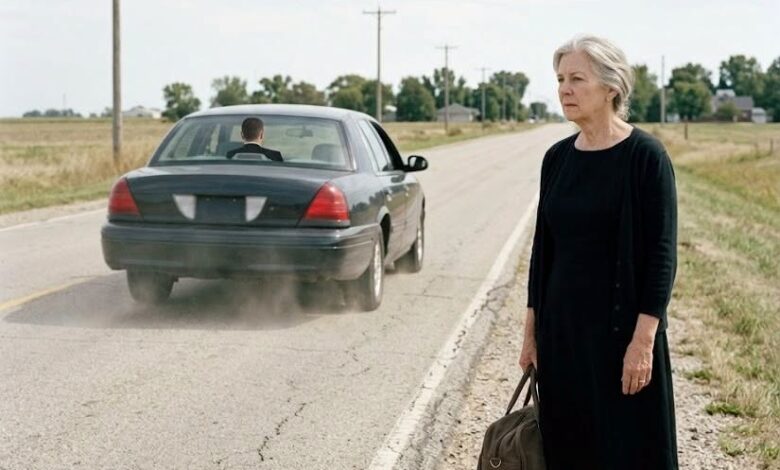
I looked down at my black dress, my dust-covered shoes, and the small handbag beside me.
Only an hour earlier, my son had left me beside an empty road without my phone, without transportation, and without access to money.
He thought that would make me helpless.
Instead, he had removed the last reason I had to keep protecting him from consequences.
“No,” I said. “I will not give you the company.”
He hung up.
Mara remained quiet.
Then she said, “There’s something else.”
My stomach tightened.
“What?”
“He brought documents with him. He says Thomas signed them and gave him authority over the business.”
“Did you see them?”
“Yes.”
“Photograph every page.”
Within twenty minutes, Rebecca, our attorney, called me.
She had reviewed the photographs.
“They don’t say what Eric thinks they say,” she told me.
“What are they?”
“An old operational authorization. Thomas signed it years ago when Eric first started handling management duties. It allowed him to approve certain company matters as an employee.”
“And he thinks it makes him owner?”
Rebecca sighed.
“He either doesn’t understand the distinction or finds it convenient not to.”
For the first time that day, I laughed.
It wasn’t joy.
It was relief.
The truth had become simpler than fear.
My son had spent an entire afternoon trying to seize something that had already been legally protected from him.
But there was one thing I wanted immediately.
I wanted to go home.
Not to defeat Eric.
Not to prove anything.
I wanted to stand inside the house where Thomas and I had built our life and decide what remained mine besides property.
Rebecca arranged transportation.
By the time I arrived, the evening sun was falling behind the trees.
Eric was still at the company.
The house was silent.
I stood inside the doorway for a long moment.
Thomas’s chair remained beside the window.
His reading glasses were still on the side table.
One of his coffee cups sat exactly where he had left it days before he became too weak to drink from it.
For the first time since his death, the silence did not crush me.
It felt like permission.
I went upstairs and sat on our bed.
This was where Thomas had taken my hand three weeks earlier.
Where he had asked me to call Rebecca.
Where he had admitted what neither of us wanted to say aloud.
Eric had begun treating his father like an inheritance waiting to happen.
Thomas had known our son might become angry.
He knew Eric might blame me.
But he also understood something I had spent years refusing to accept:
Protecting our son from consequences was no longer the same thing as loving him.
The following morning, Eric came to the house.
He did not knock.
He opened the door as though nothing had changed.
Then he saw me sitting at the kitchen table.
“You came back.”
“I live here.”
He stared.
After several seconds, he placed a folder in front of me.
“I want to fix this.”
I didn’t touch it.
“What do you want?”
“The company.”
I almost smiled.
“No.”
He exhaled sharply.
“Then I want my share.”
“You will receive exactly what your father left you, according to the trust.”
“When?”
“When the trust says.”
His jaw tightened.
“So you’re choosing paperwork over your own son?”
“No. Your father chose responsibility over entitlement.”
That stopped him.
I pushed the folder back.
“If you want to work at the company, you may do so under the structure your father established. If you want greater responsibility someday, earn it.”
“You expect me to apply for a job at my own company?”
“It isn’t your company.”
His face flushed.
“Dad wanted me to have it.”
“Your father wanted you to become the kind of man he could trust with it.”
Eric looked away.
Then, finally, he asked something that was not about money.
“Why didn’t you tell me about the trust?”
I answered honestly.
“Because your father wanted to know who you would become if you believed nobody could stop you.”
The anger left his face slowly.
Something else replaced it.
Shame.
He picked up the folder and walked toward the door.
Then he stopped.
“Mom.”
“Yes?”
His voice was quieter.
“I’m sorry I left you on that road.”
It was the first apology that mentioned no house, company, inheritance, or lawyer.
I did not rush to forgive him.
I simply nodded.
A week later, Rebecca finalized the remaining documents. The company continued under Thomas’s plan, with me controlling the trust and Mara remaining as office manager.
The locksmith never returned.
Neither did Eric’s assumption that ownership could be inherited by force.
Months passed before he asked to come back to work.
This time, there was no demand for his father’s office.
No request for special access.
“What do I need to learn?” he asked.
That question mattered more than his apology.
I told him he could start low in management and earn authority the same way everyone else did.
Piece by piece.
He agreed.
Eric did not become a better man overnight.
People rarely change that neatly.
But for the first time, he began understanding that family was not a shortcut around accountability.
And I began understanding something too.
The woman he had left beside that deserted road no longer existed.
For decades, I had been the wife who kept the books quietly, the mother who smoothed conflict over, the woman who sacrificed first because somebody needed to.
I had allowed my contribution to become so invisible that even my own son believed the life Thomas and I built belonged only to his father.
Thomas had seen what that invisibility was costing me.
His final gift was not merely a house or control of a company.
It was protection from the habit I had of giving myself away.
The house remained mine.
The business survived.
Eric still had a future, but not one he could take by force.
And Thomas’s death no longer meant that everything we built had to pass automatically into someone else’s hands.
Months later, standing in our company lobby, I had a new plaque installed beneath a photograph of Thomas beside our first delivery truck.
It read:
THOMAS AND ELEANOR — FOUNDERS
Eric stood beside me and read it twice.
“You should’ve been on the door from the beginning,” he said.
I looked at my name.
“Yes,” I replied.
There was no anger left in the answer.
That surprised me most.
My son thought leaving me on the roadside would make me understand how powerless I was without him.
Instead, it became the first place where I remembered something I had forgotten.
I still knew how to walk.
I still knew how to build.
And for the first time in decades, I was free to decide where my own life went next.