By the time Daniel stepped away from the altar, I understood that whatever happened next was no longer mine to decide.
I had already made my choice.
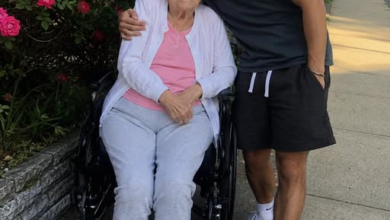
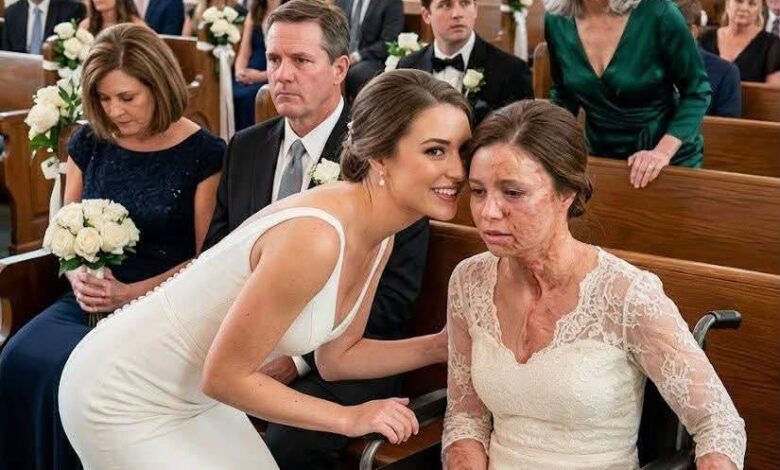
I had come to my sister’s wedding because Emily asked me to. I had worn the ivory gloves she chose, positioned my wheelchair carefully in the second row, and tried to occupy as little space as possible.
Then she leaned down and told me I was ruining the atmosphere.
The photographs.
The perfect image.
She wanted me moved to the back.
I had been preparing to do exactly that when Daniel’s mother, Margaret, stood.
“She saved your life, Emily.”
Five words.
That was all it took to stop the wedding.
Daniel turned toward his bride.
“What does she mean?”
Emily gripped her bouquet.
“Daniel, not now.”
“It became now when you told your sister to move.”
The organist stopped. The photographer lowered his camera. Around us, a church full of guests became painfully still.
I wanted to disappear.
That was the irony.
Emily had been worried that my scars and wheelchair would attract attention. Now every eye in the room seemed pointed toward me.
“I should go,” I said.
Emily exhaled.
Daniel noticed.
“Please don’t.”
I looked at him.
“Not because I want everyone staring at you,” he said. “I need to understand what happened.”
He asked Emily directly whether she had told me to move.
For several seconds, she searched our parents’ faces.
Neither rescued her.
Finally she said, “I asked her to sit somewhere else.”
“Why?”
“Everything was arranged a certain way.”
“What does that mean?”
“The pictures. The seating. We’ve spent months making everything perfect.”
Daniel looked at me.
Then back at her.
“And she makes it less perfect?”
Emily protested that he was twisting her words.
I finally spoke.
“You told me I was ruining the atmosphere and the perfect image of your wedding.”
“You’re taking it the worst possible way.”
“There isn’t a good way to take it.”
My father broke his silence.
“She said it.”
Emily stared at him.
“Dad.”
“I heard you.”
Our mother immediately tried to soften it.
“Emily’s under enormous pressure.”
There it was.
The explanation that had followed my sister through childhood.
Emily was tired.
Emily was younger.
Emily was overwhelmed.
Emily hadn’t meant it that way.
Daniel looked at my mother.
“Pressure made her ashamed of her sister?”
Linda shook her head.
“Of course not.”
“Then why didn’t anyone stop her?”
Nobody answered.
Then Daniel asked me a question I never expected.
“How did the fire happen?”
Emily immediately said, “Don’t.”
Daniel kept looking at me.
And I realized he didn’t know.
He knew I had been burned. He knew I used a wheelchair. But somehow, after all the time he and Emily had spent together, he had never been told what connected those facts to her.
“Emily was ten,” I said. “I was nineteen. The fire started downstairs, and she was trapped on the second floor.”
My throat tightened.
“The firefighters hadn’t arrived yet.”
Daniel’s expression changed.
“I went back inside.”
Emily stared down at her bouquet.
“I found her trapped beneath part of a fallen curtain. I covered her and carried her until I couldn’t. Then I crawled.”
My father covered his face.
“She got Emily out,” he whispered.
That was the entire story.
I had never expected repayment for it.
At nineteen, I hadn’t run into a burning house because I wanted a lifetime of gratitude.
My little sister was inside.
She was screaming.
I went.
What I could not accept was discovering that the body I had been left with afterward had become something she wanted hidden.
Daniel looked at Emily.
“You never told me?”
“I hate talking about it,” she said. “Whenever people hear that story, they look at me differently.”
For a moment, I understood.
Then she added, “Look what it’s doing right now. It’s taking over my wedding.”
Daniel’s face hardened.
“It wasn’t taking over anything. Your sister was sitting quietly in the second row. You made it about the fire when you tried to hide her.”
Margaret stood again.
Daniel asked how she had known.
“She told me during the wedding planning.”
Daniel stared at Emily.
“You told my mother?”
Emily’s expression tightened.
“It came up.”
Margaret’s voice remained calm.
“You told me your sister carried you out of a burning house. You used that story to explain why your family had always been protective of you.”
Emily looked away.
Margaret continued.
“I understand not wanting the worst thing that happened to you to define you. What I don’t understand is telling the story when it earns sympathy, then hiding the woman who paid the price when she complicates a photograph.”
Nobody applauded.
Nobody gasped.
Thank God.
Real pain rarely needs an audience’s reaction.
I turned my chair toward the aisle.
“Daniel, neither of you owes me anything. I’m leaving because this shouldn’t be happening in front of everyone.”
He nodded.
Then he said, “I’m sorry she put you in a position where you have to disappear to make everyone else comfortable.”
That nearly broke me.
Not because it was dramatic.
Because somebody had finally named what I had spent years doing.
Disappearing politely.
Making other people’s discomfort easier.
Daniel walked toward the officiant and picked up the card containing his vows.
Emily followed.
For one second, I thought he might continue.
Instead, he folded the card.
“I can’t say these today.”
Emily froze.
“I need to stop the ceremony.”
My mother stood.
“Please. Talk privately first.”
Emily’s voice sharpened.
“You’re canceling our wedding because my sister got offended about a seat?”
“No.”
Daniel looked directly at her.
“I’m stopping because when you believed everyone who mattered would let you humiliate her, you did it.”
Tears filled Emily’s eyes.
“So you’re choosing her?”
“No. I’m choosing not to marry someone while I’m finding out who she is.”
That distinction mattered.
He wasn’t rescuing me.
I wasn’t winning.
He was making his own decision about the person he had planned to marry.
Emily turned toward me.
“This is what you wanted.”
“I was moving to the back because you told me to.”
She had no answer.
That was the one fact nobody could rewrite.
I hadn’t confronted her.
I hadn’t exposed her.
I had been willing to disappear.
The ceremony ended.
Guests left quietly.
Margaret approached me while I waited for the aisle to clear.
“I hope I didn’t make things worse.”
“You made them louder,” I said.
She looked concerned.
“But they were already bad.”
She nodded.
In the hallway, my mother found me.
“I should have said something.”
“Yes.”
She looked startled.
Normally, I would have softened the truth immediately.
That afternoon, I didn’t.
“I didn’t want to ruin her day,” she whispered.
“She was willing to ruin mine.”
My mother began crying.
For once, I didn’t comfort her.
My father joined us.
“I failed you in there.”
No excuse followed.
That mattered.
“Yes,” I said.
Then Emily appeared without her veil.
“Are you happy now?”
“No.”
“You always get to be the good one,” she said. “The brave one. The person everyone feels sorry for.”
And suddenly I understood something.
My scars weren’t merely scars to Emily.
They were evidence of a story in which she had been helpless and I had been strong.
She had spent years resenting a debt I had never asked her to repay.
“I never needed your gratitude,” I told her. “I never asked you to introduce me as a hero. I never asked you to make the fire part of today.”
I looked down at my bare hands. At some point, I had removed the gloves.
“All I expected was not to be treated like something ugly you needed moved out of the frame.”
Emily didn’t apologize.
I’m glad she didn’t.
An apology offered while her wedding was collapsing would have belonged more to panic than understanding.
Daniel did not marry her that day. He also didn’t make some theatrical declaration that their relationship was permanently over. He told her he needed distance and that whatever happened between them would be decided later, privately.
I respected that.
Then I made my own decision.
I stopped absorbing everyone’s discomfort.
When relatives asked what happened, I told the truth without embellishment.
When my mother apologized, I stopped telling her everything was fine.
When my father apologized, I let him sit with the knowledge that he had failed me.
Emily and I did not immediately reconcile.
Some wounds need honesty before they need closeness.
Several weeks later, my parents came to my apartment for lunch.
Emily wasn’t ready.
Neither was I.
Mark brought coffee. Linda carried sandwiches.
As we approached the table, my father noticed that one dining chair was blocking the space where I normally positioned my wheelchair.
Months earlier, he might not have noticed.
Years earlier, I probably would have moved it myself.
He didn’t apologize.
He didn’t call attention to it.
He simply lifted the chair, carried it to the wall, and cleared a space beside the table.
Then he placed my coffee within reach.
No speech.
No performance.
Just room.
I looked at the empty space where the chair had been and thought about the wedding.
About the second row.
About the back of the church.
About all the years I had made myself smaller so nobody else had to feel uncomfortable looking at what survival had done to me.
My father sat across from me.
My mother opened the sandwiches.
And for the first time in a very long while, nobody asked me to move.
They moved the chair instead.