The deadbolt turned before I had decided what I was going to say.
The front door opened.
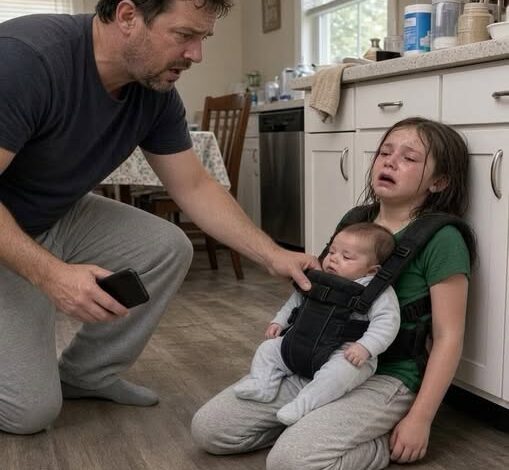
I stood in the kitchen with eight-month-old Miles against my chest and a hidden phone in my hand.
Tessa, my nine-year-old daughter, sat on the floor beside the cabinets with a half-finished glass of water near her knee.
She looked exhausted.
Their mother stepped inside.
No grocery bags.
That detail mattered because less than a minute earlier, Tessa had told me exactly what she had been instructed to say if I came home early.
Mom went to get groceries.
Their mother looked at me.
Then Miles.
Then Tessa.
Finally, her eyes landed on the phone.
She froze.
Not confused.
Not curious.
Recognizing it.
“Grant,” she said quietly. “Why do you have that?”
That told me almost everything.
Not What is that?
Not Where did you find it?
Why did I have the thing she had hidden?
“Tessa showed me.”
Her face hardened.
“Tessa, I told you never to touch that phone.”
“Don’t.”
My voice came out sharper than I intended.
Miles startled against my chest, so I lowered it immediately.
“She is nine years old. She has been alone with an infant for hours. You are not making this her fault.”
Their mother looked toward Tessa.
Tessa pulled her knees tighter against her body.
That was enough.
I carried Miles into the living room and told Tessa to sit on the couch.
“You don’t have to explain anything else tonight.”
She nodded without arguing.
That frightened me almost as much as everything else.
Normally, Tessa negotiated everything.
Bedtime.
Dessert.
How many strawberries counted as enough fruit.
That afternoon, she was too tired even to argue about where she sat.
I returned to the kitchen.
Their mother stood with both hands against the counter.
“It isn’t what you think.”
I held up the phone.
“I haven’t told you what I think.”
“Grant—”
“Who is R?”
She said nothing.
The phone buzzed.
The screen lit up.
R: Are you coming back?
Then another message.
R: You said he wouldn’t be home until tonight.
Their mother reached for the phone.
I moved it away.
“This is mine.”
“Maybe. But the messages mention me. They mention Tessa. And apparently they mention leaving our children here.”
She rubbed both hands over her face.
“I needed a break.”
I stared at her.
“A break?”
“Miles hasn’t been sleeping. Everything has been nonstop. I was supposed to be gone a few minutes.”
“Seventeen.”
She frowned.
“What?”
“You told Tessa you’d be back in seventeen minutes.”
Her mouth opened.
“And you left before lunch.”
“I lost track of time.”
“You also told her not to call me.”
“I told her to call if something happened.”
“Something happened the second a nine-year-old became responsible for an eight-month-old baby without an adult in the house.”
She flinched.
I wasn’t interested in winning an argument.
I wanted to understand how she had walked out that door and somehow convinced our daughter that asking for help would be the thing that caused trouble.
She started explaining.
Miles had been fed.
He had been sleeping.
Tessa was mature.
She was only supposed to watch him briefly.
Nothing had happened before.
None of it changed what I had found.
My daughter sitting on the kitchen floor.
Her hands shaking.
Miles crying.
And the words she had whispered when she finally called me:
Dad, I can’t hold the baby anymore.
I placed the phone on the counter.
“Unlock it.”
She stared at me.
“No.”
“Okay.”
That surprised her.
I wasn’t going to wrestle a phone out of her hands with our children ten feet away.
“But don’t tell me this was one bad decision while refusing to show me the thing that might prove otherwise.”
She glanced toward the living room.
“Can we do this later?”
“We can talk about our marriage later.”
I pointed toward the kids.
“We are talking about them now.”
That distinction mattered.
I could survive being lied to.
What I could not easily forgive was discovering that our daughter had been made part of the lie.
The phone buzzed again.
This time, their mother grabbed it.
“Please don’t do this in front of Tessa.”
“I agree.”
I nodded toward the hallway.
“So we won’t.”
I took Miles back to the couch.
For the next several minutes, I did nothing except care for my children.
I warmed food for Miles.
I brought Tessa something simple to eat.
I found her favorite blanket and placed it over her legs.
Then she asked the question I had been afraid of.
“Dad?”
“Yeah?”
“Am I in trouble?”
“No.”
She looked toward the hallway.
“Is Mom?”
“The adults are going to deal with the adult part.”
Another pause.
“Are you mad because I showed you the phone?”
“Not even a little.”
“Mom will be.”
There it was.
She wasn’t afraid of what was on the phone.
She was afraid of being blamed for exposing it.
I sat beside her.
“Tessa, listen to me.”
She looked up.
“You never have to keep a secret that makes you responsible for keeping an adult out of trouble.”
Her eyes filled.
She nodded.
A few minutes later, their mother returned.
The second phone was unlocked.
She placed it on the kitchen table.
“You can look.”
I didn’t open photos.
I didn’t search for something dramatic.
I opened the message thread with R.
The first thing I noticed was the date.
The conversation had not started that afternoon.
It had been going on for months.
Most of the messages were painfully ordinary.
My work schedule.
When Miles usually slept.
When Tessa came home.
How long their mother could disappear without anyone noticing.
Then I found one from several weeks earlier.
Same plan. She thinks I’m running errands.
Another:
Tessa knows what to say if Grant calls.
I stopped scrolling.
“What does that mean?”
Their mother stared at the table.
“Grant…”
“What does it mean?”
“There were a couple of other times.”
For a second, I thought I had misunderstood.
“You left them alone before?”
“Not like today.”
“That isn’t an answer.”
She admitted there had been shorter absences.
Once while Miles slept.
Another time when she claimed she needed to pick something up nearby.
Each time, Tessa had been told to stay inside and call only if something went wrong.
Because nothing terrible had happened before, their mother had convinced herself it was safe.
But the messages revealed something worse than one reckless decision.
There was a system.
My work schedule was part of it.
Tessa’s obedience was part of it.
The grocery story was part of it.
And the hidden phone existed because I was never supposed to see all those pieces together.
I finally asked,
“Who is R?”
She took a long breath.
“Someone I’ve been seeing.”
The answer landed.
Strangely, the affair no longer hurt most.
“Does he know Tessa is nine?”
She hesitated.
“He knows she’s my daughter.”
“And he was okay with you leaving an infant with her?”
“I made my own decisions. Don’t blame him for everything.”
That was the first thing she had said all afternoon that I completely agreed with.
“I don’t.”
I pushed the phone toward her.
“You made the decision.”
She started crying.
She told me she felt invisible.
Overwhelmed.
Trapped.
She said she wanted a few hours where she wasn’t only somebody’s wife or somebody’s mother.
I listened.
Explanations matter.
But they are not excuses.
She had every right to tell me she was exhausted.
Every right to ask for more help.
Every right to say our marriage was failing.
She did not have the right to turn our nine-year-old daughter into infrastructure for her secret life.
“I never wanted Tessa to be scared,” she whispered.
“Then why did she think calling me would make you angry?”
She couldn’t answer.
From the living room, Miles grabbed Tessa’s sleeve.
Tessa gently freed herself without upsetting him.
Even after everything she had already done, she was still caring for him.
That decided something for me.
“We’re done with the phone tonight.”
Their mother looked surprised.
“What?”
“The kids need dinner, baths, and sleep.”
“And us?”
“I don’t know.”
That was the truth.
But I knew several things immediately.
Tessa would never again be left responsible for Miles without an adult present.
Neither child would ever be used as a cover story.
Nothing about the affair would be discussed in front of them.
And until I understood exactly what had been happening, I would rearrange work to make sure appropriate childcare was always in place.
“Are you taking my children away?”
“No.”
I looked toward Tessa.
“I’m making sure they never have to wonder whether an adult is coming back.”
That night, the house looked exactly the same.
Same kitchen.
Same refrigerator humming.
Same stack of mail beside the door.
But every ordinary thing felt different.
At 1:17 that afternoon, the hidden phone had received a message.
Before lunch, their mother had left.
Seventeen minutes was what Tessa had been promised.
Hours later, I had found my daughter sitting on the floor because she physically could not keep holding her baby brother.
Those were not interpretations.
They were facts.
Over the next several days, their mother and I talked privately.
She admitted the meetings with R had happened more than once.
She admitted Tessa had been given cover stories before.
She admitted she had convinced herself that because Tessa was responsible and Miles was usually calm, leaving them briefly wasn’t truly dangerous.
She admitted she had been wrong.
I didn’t need a dramatic confession.
I needed change.
I rearranged my schedule.
Canceled what I could not cover safely.
Made sure Miles’s care never depended on Tessa filling a gap created by adults.
Most importantly, I stopped asking Tessa questions about her mother.
She had already been burdened with enough information that never belonged to her.
One evening, while I washed bottles, she asked,
“Should I have called you sooner?”
I put the bottle down.
“You called when you needed help. That’s exactly what you were supposed to do.”
“Even if someone tells me not to?”
“If you or Miles don’t feel safe, yes.”
“What if they get mad?”
I smiled.
“Then they can be mad at me.”
That finally made her smile.
The adult relationship took longer.
There was no perfect apology.
No single conversation that restored trust.
Their mother ended the relationship with R.
I did not pretend that erased what had happened.
We separated while we worked out parenting arrangements and decided whether there was anything left to rebuild between us.
The harder part was not whether I trusted her again.
It was teaching Tessa that when an adult said they would be there, they actually would be.
At first, she watched the clock whenever I left the room.
She asked exactly how long grocery trips would take.
She checked whether someone else would stay with Miles.
Then slowly, those questions became less frequent.
Weeks became months.
The hidden phone stayed turned off.
After the messages we needed were preserved, I put it away.
Not because switching it off erased the truth.
Because we no longer needed a buzzing screen to tell us what had happened.
One Saturday afternoon, I sat on the living-room floor playing with Miles.
Tessa was beside us drawing.
Miles crawled toward her and grabbed her sweatshirt.
She laughed.
Then she looked at me.
“Dad?”
“Yeah?”
“Can I hold him?”
The question hit me harder than she could have known.
Not because she hadn’t held Miles since that afternoon.
Because this time, holding him was something she wanted.
Not something an adult had assigned her.
“Of course.”
I lifted him into her lap.
“But I’m right here.”
Miles immediately grabbed a fistful of her hair.
“Ow! Dude!”
Tessa laughed while I freed it from his fingers.
Two minutes later, he started squirming.
She looked at me.
“Dad, take him.”
I reached out immediately.
No hesitation.
No promises about being back in seventeen minutes.
No hidden phone.
No little girl wondering how much longer she was responsible.
She handed Miles back, stretched her arms over her head, and returned to drawing.
That was when I knew something important had changed.
Not the marriage.
I still did not know what would happen there.
But my daughter had learned that she could say:
I’ve had enough.
And an adult would listen.
Months later, their mother and I decided not to reconcile.
We became co-parents instead.
There were attorneys.
Counseling appointments.
Schedules.
Uncomfortable conversations.
But we agreed on one thing.
Our children would never again carry the consequences of our adult failures.
Their mother eventually apologized directly to Tessa.
Not for the affair.
Tessa did not need that burden.
She apologized for leaving her responsible for Miles and for making her believe she had to lie.
Tessa listened.
Then said something neither of us expected.
“Okay. But don’t make me do it again.”
Her mother cried.
“I won’t.”
And she didn’t.
A year later, Miles was running instead of crawling.
Tessa was ten.
One afternoon, I found them together on the living-room rug.
Miles was trying to build a tower while Tessa kept knocking it over just to make him laugh.
Their mother arrived for pickup and stood near the door.
Tessa looked at her.
Then at me.
“Can I stay five more minutes?”
“Sure.”
Five minutes later, she stood.
“Okay. I’m ready.”
Nobody told her to wait.
Nobody told her she was responsible for anybody else.
Nobody made her afraid to ask for what she needed.
She simply picked up her backpack and walked toward the door like a child should.
I looked toward the kitchen where I had found her more than a year earlier.
For a long time, I thought the worst thing I discovered that afternoon was the hidden phone.
It wasn’t.
The worst thing was realizing how much responsibility my daughter had quietly learned to carry.
The best thing was watching her finally put it down.
And every time she handed Miles back to me and returned to being his sister instead of his caretaker, I remembered the promise I made that first night.
She would never again have to become the adult because the adults had disappeared.
THE END