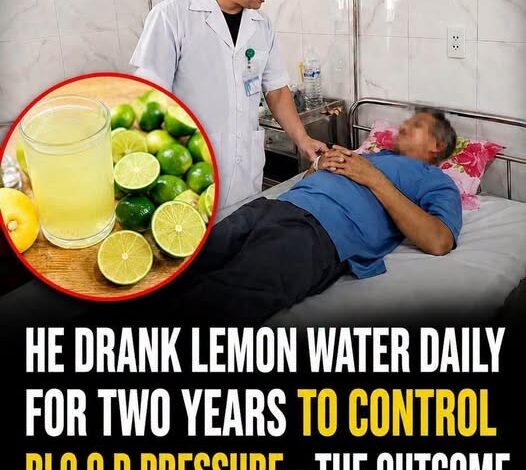
He walked into the doctor’s office expecting praise.
For months, he had been convinced he was taking control of his health. Every morning began the same way: before coffee, before breakfast, before checking his phone, he squeezed fresh lemon into a glass of water and drank it slowly.
It wasn’t just a beverage.
It had become a ritual.
A symbol of discipline.
A promise to himself that he was doing something good for his body.
He had read countless articles online praising lemon water. Social media posts called it a natural cleanser. Wellness influencers claimed it could support heart health, detoxify the body, and even help manage blood pressure. The message was everywhere: simple habits could transform your health.
He wanted to believe it.
So he did.
Every morning, as he drank that tart, refreshing glass, he felt reassured. He imagined he was staying one step ahead of illness. He imagined he was making responsible choices. Most importantly, he imagined he was protecting himself.
That belief followed him all the way into the examination room.
When the nurse wrapped the blood pressure cuff around his arm, he wasn’t worried.
When she frowned slightly at the reading, he assumed it was a mistake.
When she repeated the measurement, he remained calm.
Surely everything was fine.
Then the doctor entered the room.
The conversation that followed changed everything.
“Your blood pressure is very high,” the doctor said carefully.
Not slightly elevated.
Not borderline.
Dangerously high.
The words hit him harder than he expected.
For a moment, he thought there had to be some kind of error.
How could that be possible?
He exercised occasionally.
He wasn’t ignoring his health.
He drank lemon water every single day.
Wasn’t that supposed to help?
The doctor continued explaining the numbers, the risks, and the need for immediate attention, but part of him was still stuck on one thought.
How had this happened?
The drive home felt different.
The world outside the car window looked the same, but something inside him had shifted.
He felt confused.
Disappointed.
Even betrayed.
Not just by his body, but by the belief system he had built around that morning routine.
For months, the lemon water had made him feel protected.
It had made him feel responsible.
It had given him a sense of control.
Now he was forced to confront a difficult truth:
The habit had never been a treatment.
It had never been powerful enough to manage a serious medical condition.
It had simply made him feel as though he was addressing the problem while the real danger continued quietly beneath the surface.
And beneath that realization was something even more uncomfortable.
Fear.
Not fear of lemon water.
Fear of what he had been avoiding.
Fear of medication.
Fear of hearing bad news.
Fear of doctors telling him something he didn’t want to hear.
Fear of acknowledging that some health problems cannot be solved by simple wellness trends.
Many people understand that fear.
It often disguises itself as optimism.
We tell ourselves we’ll exercise more next month.
We’ll eat healthier soon.
We’ll try a natural remedy first.
We’ll see if things improve on their own.
Those promises feel comforting because they allow us to postpone difficult realities.
That’s exactly what had happened to him.
Lemon water became more than a drink.
It became a shield.
A way to believe he was handling the problem without fully facing it.
The drink itself wasn’t harmful.
The belief attached to it was.
Because while he trusted the ritual, his blood pressure continued rising.
While he relied on a wellness habit, a serious medical condition progressed quietly.
While he searched for simple answers, his body needed something more.
Eventually, he made a decision.
Instead of avoiding the problem, he would address it.
Under medical supervision, he began a treatment plan.
At first, he resisted the idea of medication.
Part of him viewed it as failure.
As though needing help somehow meant he hadn’t tried hard enough.
But over time, he began to see things differently.
Taking medication wasn’t surrender.
It was responsibility.
The same responsibility he thought he had been showing all along.
He started prescribed blood pressure medicine.
He attended regular follow-up appointments.
He monitored his numbers at home.
He worked with healthcare professionals instead of relying solely on internet advice.
His approach to diet changed as well.
Rather than focusing on trendy health habits, he paid closer attention to evidence-based recommendations. He reduced his sodium intake. He became more aware of processed foods. He learned which choices genuinely affected blood pressure and which ones were mostly marketing.
Exercise became more intentional too.
Instead of occasional efforts driven by guilt, he followed a consistent routine designed to support cardiovascular health.
Slowly, the numbers improved.
Not overnight.
Not dramatically.
But steadily.
Each appointment brought evidence that real treatment was working.
That lesson stayed with him.
Managing blood pressure, he realized, was rarely about one magical food, one special drink, or one viral health trend.
It was about consistency.
It was about science.
It was about accepting reality instead of chasing shortcuts.
Most importantly, it was about understanding that good intentions alone are not always enough.
The body sometimes requires more support than hope can provide.
Interestingly, lemon water never disappeared from his life.
He still drank it most mornings.
He still enjoyed the fresh taste.
He still appreciated the ritual.
But the meaning had changed completely.
Before, it had represented a cure.
Now, it represented something far healthier.
Perspective.
The lemon water wasn’t medicine.
It wasn’t controlling his blood pressure.
It wasn’t replacing professional care.
It was simply a pleasant habit that existed alongside real treatment.
That distinction may have saved his life.
Because the greatest danger had never been the lemon water itself.
The danger was believing that “natural” automatically meant effective.
The danger was assuming that needing medication signaled weakness.
The danger was placing faith in comforting ideas without demanding evidence.
Many people fall into the same trap.
They mistake wellness trends for solutions.
They confuse popularity with proof.
They believe that if something feels healthy, it must be enough.
But health is rarely that simple.
Sometimes the most courageous thing a person can do is stop searching for easy answers.
Sometimes the bravest choice is making the appointment you’ve been avoiding.
Taking the medication you don’t want to need.
Listening to the diagnosis you hoped wasn’t true.
Accepting help.
For him, that was where real healing began.
Not with the lemon water.
Not with a wellness article.
Not with a social media recommendation.
It began the moment he stopped confusing comfort with treatment.
It began the moment he stopped seeing medical care as failure.
It began the moment he accepted that caring for himself meant using every appropriate tool available—including professional healthcare.
Today, he still starts many mornings with a glass of lemon water.
But he drinks it with a different understanding.
It supports his routine.
It does not replace his treatment.
It complements healthy choices.
It does not cure disease.
And that lesson extends far beyond blood pressure.
Healthy habits can improve a life.
They can support well-being.
They can help build a stronger future.
But they should never become substitutes for the care that health—and sometimes life itself—may depend on.