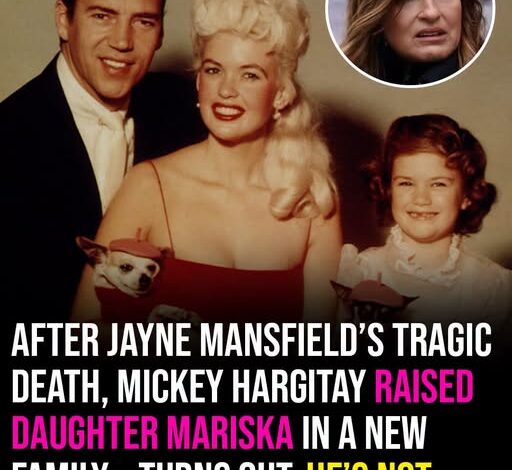
For most of her life, Mariska Hargitay believed the story of her family was complete.
She knew tragedy had shaped her childhood. She knew her mother, Hollywood icon Jayne Mansfield, had died in a devastating car accident when Mariska was just three years old. And she knew that Mickey Hargitay—the strong, devoted man who raised her—was her father. That truth had never been questioned. It was the foundation upon which her entire identity had been built.
Then, in a single unexpected moment, everything changed.
A chance encounter with another man’s face stirred something she could not explain. The resemblance was too striking to dismiss, planting a question she had never imagined asking. What began as a fleeting feeling soon became an emotional journey that challenged everything she believed she knew about her origins.
The discovery did not simply raise questions about biology.
It reached into the deepest parts of identity.
Who are we?
How much of ourselves comes from genetics?
Can an unexpected truth alter a lifetime of love?
For Mariska, those questions arrived all at once, bringing confusion, grief, and uncertainty. The realization that another man might be her biological father forced her to confront emotions she had never expected to carry—questions about heritage, belonging, abandonment, and whether the story she had always accepted had hidden painful chapters no one had spoken aloud.
Yet amid all the uncertainty, one truth remained unchanged.
Mickey Hargitay had been there.
He was the man who comforted her after nightmares, celebrated her achievements, guided her through childhood, and stood beside her through life’s most important moments. Every scraped knee, every school event, every success and disappointment had been shared with the father who chose to raise her with unwavering love.
When Mariska eventually confronted Mickey with what she had learned, the conversation was deeply emotional. For him, the revelation reopened old wounds and fears that had long remained buried. The possibility of losing his daughter’s certainty was heartbreaking, not because of biology, but because of the life they had built together.
That moment became a turning point.
Rather than weakening their relationship, it ultimately revealed just how powerful it truly was.
Mariska came to understand that fatherhood is measured by far more than shared DNA. Biology can explain where life begins, but it cannot account for years of sacrifice, guidance, patience, and unconditional love. Those are choices made day after day, and Mickey had made them throughout her entire life.
At the same time, Mariska felt compelled to understand the other part of her story.
Meeting Nelson Sardelli, the man later identified as her biological father, was not about replacing one family with another. It was about acknowledging a truth that had existed all along, even if it had remained hidden. Their first encounters required patience, honesty, and the willingness to navigate emotions that had no simple answers.
Relationships built after decades of separation cannot erase the years that came before. They unfold gradually, shaped by careful conversations, mutual respect, and the recognition that everyone involved has experienced loss in different ways. As Mariska slowly came to know Sardelli and members of his family, she discovered that embracing one truth did not require rejecting another.
Instead of choosing between two identities, she found room for both.
The process was not without pain.
Hidden family histories rarely emerge without difficult emotions. There were moments of sadness for the years that could never be recovered, questions that remained unanswered, and relationships that required time to grow. Yet alongside those challenges came unexpected healing—the realization that truth, even when difficult, can become the beginning of understanding rather than its end.
Eventually, Mariska chose to share her family’s story publicly through her documentary. In doing so, she transformed a deeply personal secret into a conversation about identity, love, and the many forms family can take. By speaking openly, she lifted the weight of silence she had carried for so long and offered others permission to confront complicated family histories with honesty and compassion.
Her story resonates because it reflects a reality many people understand in different ways. Families are rarely defined by biology alone. They are shaped by commitment, presence, forgiveness, and the countless everyday moments that create lasting bonds. The people who raise us, encourage us, and stand beside us through life’s challenges often become family in the deepest sense of the word, regardless of genetics.
Looking back, Mariska did not lose the father who had always loved her.
She gained a fuller understanding of herself.
She discovered another branch of her family’s story without diminishing the man who had been her father in every way that mattered. The truth expanded her life rather than replacing it, allowing grief and gratitude to exist side by side.
In the end, her journey became far more than a search for biological answers. It became a testament to the idea that love is not limited by bloodlines. Identity is not erased by new discoveries, and family is often larger, more complex, and more beautiful than we first imagine.
Sometimes the truths we fear most do not take love away.
They simply reveal how much room the heart has to hold it.