The second pounding at the front door was harder than the first.
This time, my husband stopped moving.
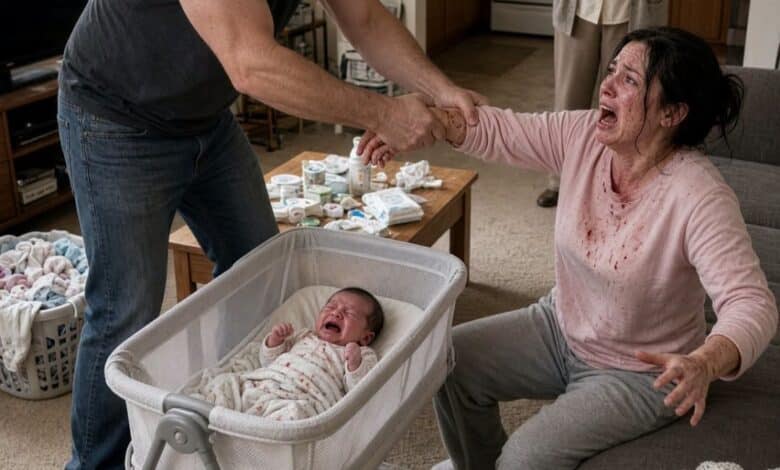
Our newborn was still crying against my chest. My face throbbed where he had hit me, my lip tasted like blood, and every breath pulled painfully through the bruises spreading beneath my skin.
Across the room, my mother-in-law stared at the door as though the police had arrived because of me.
Then she leaned close.
“Tell them nothing happened,” she whispered. “Do you understand?”
I looked at her.
And for the first time, I did not answer.
For weeks, I had explained everything away.
My husband was tired.
He was under pressure.
Babies were expensive.
He hated the cost of formula, complained about diapers, questioned doctor visits, and studied receipts as if every purchase were proof that I was wasting his money.
I kept telling myself exhaustion had changed him.
That night proved otherwise.
Our baby had woken crying for milk.
My husband looked at the formula can and snapped, “The baby already ate.”
“She’s hungry.”
“She’s always hungry.”
I reached for our child.
He got there first.
His hands closed around the baby’s neck.
I still remember the silence that followed.
The crying stopped.
The tiny face changed color.
The lips began turning blue.
I threw myself at him and tore our baby free.
“Breathe,” I begged, clutching that small body against my chest. “Please breathe.”
A faint gasp came.
Then another.
Then crying.
I had never been so grateful for a sound.
My husband should have been horrified.
Instead, he looked angry.
“You think you can fight me?”
“You almost killed her!”
He hit me.
Once.
Then again.
By the third blow, the room tilted.
I remember falling.
I remember blood filling my mouth.
And I remember wrapping both arms around the baby because even while collapsing, I knew one thing clearly.
Do not let go.
My mother-in-law watched everything.
I begged her to help.
“Take the baby. Call someone.”
She did neither.
Instead, she looked at me with the same cold impatience she had always used whenever her son lost control.
“He needs somewhere to release his anger,” she said. “You’re his wife. You should know how to handle him.”
I stared at her.
“And the baby?”
She said nothing.
That silence changed me.
Until then, some part of me had still believed there was a line they would not cross.
That if things became bad enough, she would intervene.
That if she saw her grandchild turning blue, instinct would overpower loyalty.
It didn’t.
And suddenly I understood.
No one in that house was going to protect my baby except me.
The diaper bag was beside the sofa.
My phone was inside.
I reached for it while keeping the baby pressed against my chest.
My hands shook so badly I nearly dropped it.
I managed to place an emergency call.
I couldn’t speak.
So I left the line open.
My mother-in-law kept talking.
“You’re making this family look terrible.”
I said nothing.
“A good wife knows how to keep her husband calm.”
The dispatcher was hearing everything.
“Stop crying. It only makes him angrier.”
Every word traveled through that phone.
Eventually, my husband noticed the screen glowing beneath the edge of the diaper bag.
His expression changed.
“What are you doing?”
“Nothing.”
He stepped toward me.
“Give me the phone.”
Then someone slammed a fist against the front door.
“Police. Open the door.”
Now, finally, my husband understood the night had changed.
He opened it.
Two officers entered, followed by emergency responders.
The transformation in him was immediate.
He straightened his shirt.
Lowered his voice.
Controlled his posture.
He became the man strangers always saw.
“She’s emotional,” he said calmly. “She just had a baby.”
I stared at him.
“There was an argument,” he continued. “That’s all.”
My mother-in-law stepped in instantly.
“My son is exhausted. She’s been very emotional lately.”
One officer looked at her.
Then at me.
Then at the baby.
For several terrifying minutes, I wondered whether they might believe them.
Then the officer asked, “Did you call emergency services?”
I nodded.
“Were you able to speak?”
I shook my head.
He looked at my phone.
“The line stayed connected.”
My husband went pale.
The dispatcher had heard our baby crying.
She had heard my mother-in-law telling me to absorb her son’s anger.
She had heard my husband demanding the phone.
The room changed.
Nobody was debating whether something had happened anymore.
One responder gently took my baby and began checking her.
Another officer told my husband to step into the hallway.
“I haven’t done anything.”
“Sir, step outside.”
He looked toward his mother for support.
She looked away.
That frightened him more than the police.
The responders said the baby needed immediate medical evaluation.
I tried to stand.
My legs buckled.
An officer noticed my face.
“How did these injuries happen?”
My husband answered from the hallway.
“She fell.”
I looked at him.
He would have said anything.
The officer turned back to me.
“Ma’am?”
I swallowed.
“My husband hit me.”
My mother-in-law interrupted.
“That isn’t what happened.”
The officer lifted one hand.
“Let her speak.”
Something about those three words nearly broke me.
Let her speak.
No one had said that in a long time.
I told them the truth.
Then, as I was being helped toward the door, my mother-in-law spoke behind me.
“I need to correct something.”
Everyone stopped.
Her voice had lost its certainty.
“I saw him grab the baby,” she said.
My husband snapped around.
“Mom!”
She flinched.
“I didn’t think he would actually hurt the child.”
The officer asked how long she had been worried.
Her answers came slowly.
Then faster.
She admitted he had complained repeatedly about formula.
That he had threatened to “make me regret” spending money.
That his anger had been getting worse.
That she knew enough to be afraid.
My husband began shouting.
“She’s lying to save herself!”
His mother looked at him for a long time.
Then said quietly, “I should have helped her the first time.”
It was the first honest thing I had ever heard her say.
It did not erase what she had done.
It did not make her innocent.
But it ended the lie.
At the hospital, doctors examined my baby again and again.
Every time someone said “stable,” I breathed a little easier.
But stable was not the same as safe.
A detective came later.
He asked for everything.
So I gave it to him.
The arguments over formula.
The diaper counting.
The receipts.
The threats.
The way my husband watched every expense connected to our baby as though feeding his child were an act of betrayal.
The times I had been frightened before.
The things his mother had told me.
The detective never asked why I stayed.
He never asked why I had not left sooner.
He simply listened.
That mattered.
The emergency call mattered too.
My husband tried to argue that it proved nothing because I had never spoken.
But silence did not mean nothing.
The recording contained the crying.
The threats.
The demands.
My mother-in-law’s voice.
My husband realizing help was coming.
It was not a silent call.
It was a frightened one.
The next morning, I learned my husband had been taken into custody.
His mother gave a fuller statement.
Then another.
Her story changed where fear had once shaped it, but she eventually admitted enough to make denial impossible.
Days later, she sent me a message.
I’m sorry.
I understand if you never forgive me.
I read it once.
Then closed my phone.
Because forgiveness was not the decision in front of me.
Safety was.
I did not return to that house.
Neither did my baby.
I stopped answering messages passed through relatives.
I stopped explaining.
I stopped protecting the reputation of people who had endangered my child.
Weeks later, the bruises on my face had faded.
My baby’s breathing was normal.
Sometimes I caught my reflection and barely recognized the woman looking back.
But one memory stayed sharper than all the others.
Not the police pounding on the door.
Not my husband’s face when he realized the call had stayed open.
Not even his mother finally admitting the truth.
It was the moment before all of that.
The moment I looked down at my baby and understood that waiting for someone else to become brave could cost my child everything.
That was when I stopped waiting.
My husband had believed formula made our baby expensive.
His mother had believed his anger was something we were supposed to absorb.
I had believed I could keep the peace if I chose the right words, spent less, stayed quieter, and endured longer.
I was wrong.
Peace did not begin when he calmed down.
It began when I stopped treating violence like a family problem I had to solve alone.
The next time my baby cried for milk, we were in a hospital room.
No one counted the scoops.
No one complained about the price.
No one told me the baby had eaten enough.
My child cried.
I lifted her into my arms.
I prepared the bottle.
And as she drank, one tiny hand wrapped around my finger.
For the first time in weeks, I heard her cry without being afraid of what would happen next.
That was when I understood what safety sounded like.
Not silence.
A hungry baby crying because she knew someone would come.