My husband’s question stopped me cold.
“Ask him what he did yesterday.”
Our four-year-old son went completely still in my arms.
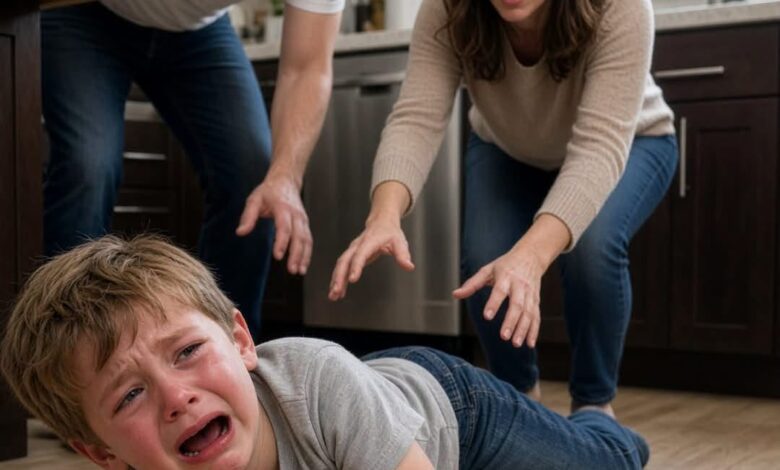
His injured hand was tucked against his chest, already swelling, while police and paramedics documented what had happened in our kitchen. Minutes earlier, my husband had insisted the drawer crushing Caleb’s fingers was an accident.
Now he was pointing at our child as though Caleb were the one on trial.
“What are you talking about?”
Daniel gave an impatient laugh.
“He knows.”
Caleb buried his face against my neck.
That was enough.
I carried him away.
I wasn’t going to make a frightened four-year-old defend himself to the man who had just hurt him.
While a paramedic examined Caleb’s hand, Daniel transformed again.
The rage disappeared.
His voice lowered.
He apologized.
He was overwhelmed.
He loved his son.
He had never meant for anyone to get hurt.
But explanations couldn’t erase what I’d witnessed.
Caleb had been screaming on the floor.
Daniel had stood over him and insulted him instead of helping.
When paramedics prepared to take Caleb for further medical evaluation, Daniel stepped forward.
“I’m his father. I’m going.”
Caleb’s good hand twisted into my shirt.
“No.”
Barely a whisper.
But everyone heard it.
I looked at the officer.
“He stays with me.”
At the hospital, doctors treated Caleb while staff documented the injury and what I’d reported. Daniel remained outside the treatment area.
For the first time all day, we had quiet.
I wanted desperately to ask Caleb what his father had meant.
What did you do yesterday?
But Caleb wasn’t a witness I needed to interrogate.
He was my son.
So when the doctor asked whether I had other safety concerns, I told her only what I knew.
“He asked me not to leave him alone with his father anymore.”
Her expression changed.
I told her what Daniel had said after hurting him.
I told her about the bathroom.
I told her I was beginning to suspect there were things happening while I was at work that I knew nothing about.
She didn’t make instant conclusions.
She documented the information and explained that the appropriate child-safety procedures would follow.
When I returned to the waiting area, Daniel was against the wall.
“Are you happy now?”
I stopped.
“What?”
“You called police. You brought him here. You’ve made me look like some monster.”
There it was.
Not How is Caleb?
Not What did the doctor say?
Him.
His reputation.
His consequences.
“I made one mistake,” he said.
“One?”
The word escaped before I could stop it.
Daniel stared at me.
“What does that mean?”
“It means I’m beginning to understand today wasn’t the first time.”
He looked away.
That tiny reaction frightened me more than an argument would have.
Then he pulled out his phone and walked toward the end of the corridor.
His voice was low, but I heard one sentence.
“I need you to tell me exactly what he said.”
I walked toward him.
“Who are you talking to?”
He ended the call.
“No one.”
“You asked somebody what Caleb said.”
“You misunderstood.”
Of course.
Whenever reality became inconvenient, I had misunderstood it.
“Who was here with him yesterday?”
“I told you. Me.”
“You told me to ask Caleb what he did yesterday.”
Silence.
Then Daniel said something I would never forget.
“You don’t understand what he’s like when you’re not around.”
“What is he like?”
Daniel began listing offenses.
He left toys on the floor.
He cried when frustrated.
He refused certain foods.
He forgot to put cups in the sink.
He spilled drinks.
I listened in disbelief.
“You’re describing a four-year-old.”
“He has to learn.”
“What did you do when he didn’t?”
Daniel’s eyes hardened.
“That depended on whether he listened.”
Before I could ask another question, a nurse appeared.
“Your son is awake.”
I went immediately.
Caleb looked toward the doorway.
“Is Daddy coming?”
“Not right now.”
His entire body relaxed.
That reaction settled something inside me.
I sat beside him.
“You can tell me anything. You won’t be in trouble.”
Then I stopped.
No more questions.
No prompting.
I simply held his good hand.
Eventually, Caleb spoke.
“Yesterday Daddy put me in the laundry room.”
I kept my voice steady.
He said he’d spilled juice.
Daniel had put him inside and told him he could come out after he apologized.
Caleb didn’t understand time well enough to tell me how long he’d been there.
Then he whispered, “Grandma heard me.”
Daniel’s mother.
I remembered something from several weeks earlier.
She had called while I was working.
“Everything okay at home?”
I’d laughed.
“Of course.”
She’d gone strangely quiet.
Then she’d said she was probably worrying about nothing.
I had forgotten the conversation.
Now my phone rang.
Her name appeared.
I answered.
She sounded like she’d been crying.
“I heard about Caleb.”
“How?”
“The police contacted me. My name came up.”
My stomach tightened.
Then she said, “I should’ve told you.”
She had heard Caleb crying behind the laundry-room door before.
More than once.
Daniel called it discipline.
He told her not to interfere.
Once, she opened the door because Caleb was begging.
Daniel became furious.
He warned her that if she wanted to remain part of the family, she needed to stop undermining him.
“And you listened?”
Her crying became harder.
“Yes.”
I closed my eyes.
She apologized.
I wasn’t ready to tell her it was okay.
Because it wasn’t.
Her silence had consequences too.
But she kept talking.
Two days earlier, Daniel had complained that Caleb had made another mess at the kitchen table.
“What kind of mess?”
“Milk.”
I looked at my son’s bandaged hand.
The milk in our kitchen hadn’t created the pattern.
It had exposed it.
For years, I’d separated every frightening moment.
The slammed door belonged to one argument.
The hole in the wall belonged to another.
Daniel grabbing Caleb too roughly was an isolated bad day.
The screaming was stress.
The apologies meant remorse.
Each event lived inside its own little box because connecting them would have required me to admit what our home had become.
Now those boxes were breaking open.
The insults.
Fear.
Hidden punishments.
Threats.
Apologies.
Silence.
And finally my child’s injured hand.
Daniel appeared outside the hospital room.
The nurse stopped him.
“Can we talk?” he asked me.
“No.”
“You can’t keep me from my son.”
I looked at him.
“I’m not making that decision by myself anymore.”
Something changed in his face.
For the first time, Daniel seemed to understand that his familiar cycle wasn’t going to work.
He couldn’t frighten us privately and become reasonable publicly, then wait for me to smooth everything over.
There were medical records now.
Statements.
Witnesses.
People whose job wasn’t protecting his reputation or our marriage.
An officer later asked whether I would provide a fuller account.
“Yes.”
“Anyone else who may have information?”
That question opened another door in my memory.
A neighbor who once asked why Caleb cried so much when Daniel watched him.
My sister telling me Caleb seemed unusually quiet around his father.
Daniel’s mother asking whether everything was okay.
People had seen fragments.
I had supplied explanations.
I gave the officer the names.
What followed wasn’t immediate or simple.
There were interviews, safety planning, medical follow-up, legal proceedings, and professionals determining what could actually be established.
I learned not to promise Caleb outcomes I couldn’t control.
Instead, I promised him things I could.
“You can tell me when you’re scared.”
“You don’t get punished for asking for help.”
“You don’t have to protect grown-ups from consequences.”
And the most important:
“You never have to be perfect to deserve safety.”
Months later, Caleb spilled milk again.
We were living somewhere else by then.
The glass tipped at breakfast and rolled across the table.
Caleb froze.
I watched his face.
For one terrible second, he wasn’t seeing me.
He was remembering.
“I’m sorry.”
I grabbed a towel.
“Okay.”
His eyes searched mine.
“Am I bad?”
My heart broke all over again.
“No.”
“But I spilled it.”
“You spilled milk.”
I handed him another towel.
“That’s a mess. It’s not a character description.”
He considered this with the solemnity only a four-year-old could bring to spilled milk.
Then he helped me clean it.
A little later, he knocked his spoon onto the floor.
He looked at it.
Looked at me.
Then sighed dramatically.
“Another mess.”
I smiled.
“Apparently you’re having a difficult morning.”
He giggled.
That sound meant more to me than any courtroom result ever could.
Daniel once asked whether I was really willing to destroy our family over spilled milk.
Eventually, I understood how backwards the question was.
The milk hadn’t harmed our family.
Neither had the police call.
Neither had the hospital.
Neither had Caleb telling the truth.
Those things exposed harm that already existed.
For years, I had believed peace meant nobody outside our walls knowing what happened inside them.
Now I knew better.
Silence wasn’t peace.
An apology wasn’t change.
And keeping a family together wasn’t noble if one of its smallest members had to live in fear to hold it there.
One evening, Caleb climbed into bed and asked the question he’d begun asking whenever life felt uncertain.
“Mommy?”
“Yeah?”
“Are you here tomorrow?”
“Yes.”
“And after tomorrow?”
“Yes.”
He thought for a moment.
“What if I spill something?”
I kissed his forehead.
“Then we’ll need a towel.”
He smiled.
That was the answer he’d been waiting for.
Not that he’d never make another mistake.
Not that nothing bad would ever happen again.
Only that ordinary childhood mistakes would be allowed to remain ordinary.
A spilled cup would require cleaning.
A broken toy might require an apology.
A tantrum might mean calming down.
But none of those things would ever again determine whether my son deserved gentleness.
For years, I had waited for Daniel to become safe.
Caleb taught me that I had been asking the wrong question.
The question wasn’t whether Daniel might someday change.
It was whether my son was safe today.
And once I finally asked that question, I stopped mistaking silence for peace.