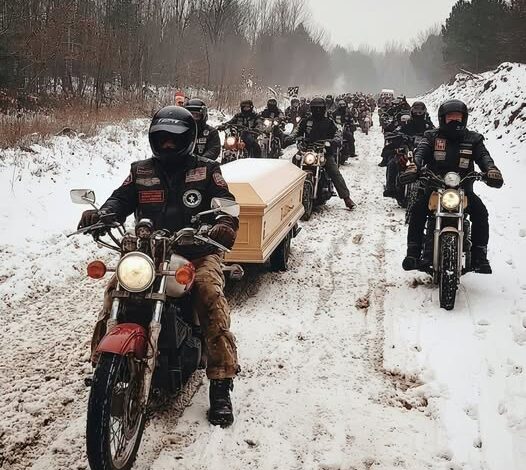
The first motorcycle appeared through the snow just after dawn.
Then another emerged behind it.
And another.
Within minutes, the frozen highway was filled with headlights.
They weren’t riding for a rally.
They weren’t chasing attention.
They were escorting a fallen Marine home.
And before the journey began, they had made one promise to his family:
He would not travel the final miles alone.
The weather seemed determined to test that promise.
Wind pushed sheets of snow across the road, reducing visibility until vehicles ahead became little more than shadows. Ice gathered along the shoulders. Temperatures fell low enough that even heavy gloves struggled to keep fingers warm.
Nobody would have blamed the riders for turning back.
They kept going.
At the center of the convoy was the vehicle carrying the Marine’s flag-draped casket.
Around it rode veterans, military families, motorcycle groups, and ordinary people who had heard about the escort and decided they needed to be there.
Some had served decades earlier.
Some had sons and daughters currently in uniform.
Others had never worn a military uniform at all.
They didn’t need identical histories.
They needed only the same destination.
Home.
For the Marine’s mother, that word no longer meant what it once had.
Home had been the place where her son dropped his bags inside the doorway.
Where his old belongings remained exactly where he’d left them.
Where she could recognize his footsteps before seeing his face.
Now she was waiting for him to return in a way no parent imagines.
People had offered condolences.
They’d said the familiar things grieving families hear.
“We’re so sorry.”
“He was a hero.”
“We’ll never forget him.”
She appreciated every word.
But grief had turned language into something distant.
What could anyone possibly say that would change the empty chair at the table?
Then she heard about the riders.
At first, she imagined a handful of motorcycles accompanying the procession for part of the route.
She was wrong.
Word had spread.
Veterans called other veterans.
Military families contacted friends.
Local groups shared the route.
People began arranging places where the convoy could stop.
Nobody had been ordered to do it.
Nobody was being paid.
They simply came.
At one stop, volunteers waited with steaming coffee.
At another, someone had prepared food.
An older veteran stood beside the road holding an American flag despite the cold.
A family arrived with their children bundled in winter coats.
Some people shook the riders’ hands.
Others didn’t say anything.
They simply stood there.
That was enough.
The convoy continued.
Mile after mile.
Snow accumulated on jackets and windshields.
Boots became soaked.
Hands stiffened around handlebars.
Whenever the group stopped, riders stamped their feet against the pavement, trying to force warmth back into them.
Then the engines started again.
Nobody complained.
Many of the veterans understood something outsiders sometimes miss about bringing a fallen service member home.
It isn’t transportation.
It’s a duty.
For generations, military culture has placed extraordinary meaning on the idea that those who serve are not abandoned.
You stay with your people.
You bring them back.
You stand beside their families when they can no longer stand easily by themselves.
The riders weren’t pretending they could repair this mother’s grief.
They couldn’t.
But they could carry a small part of its weight.
And sometimes that’s the only useful thing another human being can offer.
As the convoy moved closer to the Marine’s hometown, something began happening along the highway.
People appeared.
First a few.
Then dozens.
Then entire groups.
They stood outside businesses.
Beside gas stations.
Near intersections.
On bridges.
Some held flags.
Some saluted.
Others placed their hands over their hearts as the procession passed.
The riders couldn’t hear what anyone was saying through the engines and wind.
They didn’t need to.
The message was visible.
We know why you’re here.
We know who you’re carrying.
Keep going.
By afternoon, the storm had painted almost everything the same color.
Road.
Fields.
Rooftops.
Sky.
Yet along that pale landscape, flags kept appearing.
Red.
White.
Blue.
The Marine’s mother later struggled to explain what those strangers meant to her.
Until then, grief had felt profoundly private.
People could sympathize, but this was her son.
Her memories.
Her loss.
Then she saw photographs from the journey.
Strangers freezing beside highways.
Veterans riding through snow.
Families waiting outside simply to witness a few seconds of the procession.
Her son’s death belonged to her grief.
But his return home, somehow, belonged to thousands.
The convoy reached the outskirts of town as daylight began fading.
That was where the riders realized how many people had been waiting.
Both sides of the street were lined.
Children stood beside grandparents.
Veterans wore old unit caps.
Firefighters and first responders gathered near their vehicles.
People held flags high despite the wind.
Some had waited a long time.
Nobody seemed interested in leaving.
As the procession entered town, the motorcycles slowed.
And something remarkable happened.
The crowd became almost completely silent.
No cheering.
No applause.
No spectacle.
Only engines moving slowly through winter air.
One by one, hats came off.
Hands moved over hearts.
Veterans saluted.
People bowed their heads.
Tears ran down faces already reddened by the cold.
The Marine’s mother watched.
For days, she’d feared this moment.
She’d imagined the vehicle arriving and the terrible finality of knowing her child was truly home.
But she hadn’t imagined this.
She hadn’t imagined an entire town standing with him.
She hadn’t imagined strangers protecting his final journey.
She hadn’t imagined people who never knew his laugh or heard his childhood stories grieving beside her.
Then she understood something.
These people weren’t trying to replace him.
They weren’t trying to explain why he was gone.
They were saying something much simpler:
You do not have to stand here by yourself.
The riders eventually stopped.
Engines went quiet one after another.
For a moment, the sudden absence of noise felt enormous.
Snow continued falling.
Nobody rushed.
Several riders remained near the casket.
They had completed hundreds of difficult miles.
But their responsibility didn’t feel finished simply because the wheels had stopped turning.
An older veteran approached the Marine’s mother.
His face was weathered from the ride.
He removed one glove and extended his hand.
She took it.
For several seconds, neither spoke.
Then he said quietly:
“We brought your boy home.”
That was when she broke.
Not because the sentence told her anything she didn’t already know.
But because of the word we.
For weeks, grief had reduced her world to I.
I lost my son.
I have to bury him.
I have to wake tomorrow without him.
Suddenly, there was a we.
We carried him.
We remembered.
We showed up.
We stood in the snow.
We brought him home.
The funeral came afterward.
There were uniforms.
Flags.
Prayers.
Military honors.
The careful rituals families never want to need.
But for his mother, one image remained stronger than almost anything else.
Headlights in the storm.
A long line of motorcycles refusing to disappear into the snow.
Years later, she wouldn’t remember every condolence she’d received.
She wouldn’t remember every flower arrangement.
She wouldn’t remember precisely how cold it had been.
But she would remember strangers standing beside the road.
She would remember coffee being handed to exhausted riders.
She would remember children holding flags.
She would remember veterans who had never met her son treating his final journey as though he were one of their own.
Because to them, he was.
That’s what made the ride matter.
It wasn’t about motorcycles.
It wasn’t really about weather.
And it certainly wasn’t about creating a dramatic spectacle.
It was about presence.
The simplest form of love.
Showing up.
Showing up when there’s nothing clever to say.
Showing up when you can’t solve the problem.
Showing up when the road is dangerous, the wind hurts, and staying home would be easier.
Showing up because someone else’s grief deserves witnesses.
That winter journey didn’t bring a mother’s son back.
Nothing could.
The riders couldn’t remove the empty place at her table or give her another conversation with him.
What they could do was make certain that during one of the loneliest journeys of her life, loneliness didn’t get the final word.
A Marine needed to come home.
So they rode.
Veterans.
Parents.
Strangers.
People who knew his story and people who knew only his name.
They formed a moving wall around him and followed the road through the storm.
At every stop, someone was waiting.
A cup of coffee.
A flag.
A salute.
A hand extended in silence.
And when the convoy finally reached town, hundreds more were there.
Not because they believed standing in the snow could defeat death.
But because love has never required the ability to fix everything.
Sometimes love simply refuses to leave someone alone in the cold.
The storm eventually passed.
The motorcycles went home.
The streets emptied.
But the promise had been kept.
He had not traveled those final miles alone.
And neither had his mother.