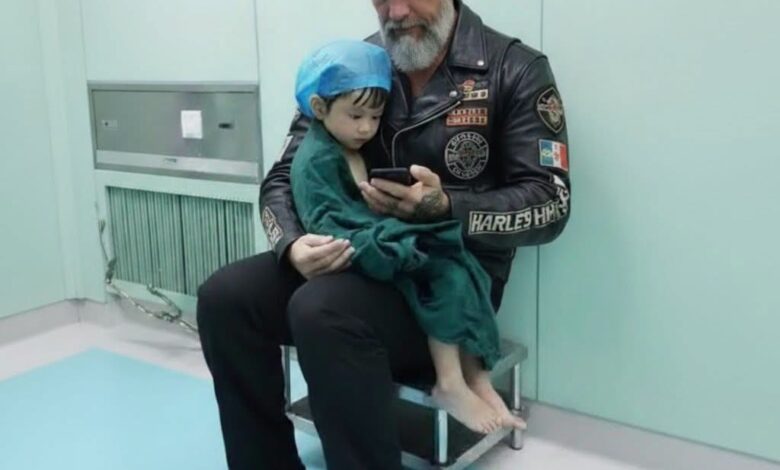
A Heartwarming Moment in the Hospital Waiting Room Between a Boy and a Stranger, asked the scary biker in the hospital waiting room to hold him instead of me

The doctors had stopped talking about treatment.
Now they were talking about comfort.
That was how I knew we were truly at the end.
My son Liam was dying.
There is no graceful way for a mother to understand those words. You can hear them clearly, understand every syllable, even nod while a doctor explains what happens next, yet some part of your mind keeps refusing to accept that they’re talking about your child.
Liam had spent so much of his young life inside hospitals that he knew the routines better than most adults.
The blood tests.
The monitors.
The medications.
The whispered conversations outside his room.
He had fought harder than anyone should ever have to fight.
But eventually, his doctors told me there was nothing more they could do to stop what was happening.
So I made the hardest decision of my life.
I took my son home.
I wanted his final days to belong to him rather than to a hospital.
His own bedroom.
His favorite blanket.
His dog sleeping beside him.
The familiar crack in the ceiling he had stared at since he was little.
The sounds of our house.
The smell of my cooking, even when he couldn’t eat much anymore.
I wasn’t looking for miracles.
I had stopped asking for impossible things.
I only wanted peace.
But before we left the hospital, something happened that changed those final days completely.
We were waiting in the lobby while paperwork was being finished.
Liam was exhausted, curled into his wheelchair beneath a blanket.
Then he suddenly looked toward the entrance.
A man had walked inside.
He was enormous.
Heavy boots.
Leather vest.
Long beard.
Tattoos covering his arms.
The kind of man some people instinctively move away from.
Liam couldn’t stop staring at him.
I leaned down.
“What is it?”
He hesitated before whispering something that nearly broke me.
“He smells like Dad.”
Liam’s father had been gone from our lives for years, but certain memories remained strangely powerful for him.
Motor oil.
Leather.
Aftershave.
The scent of someone who had once lifted him onto his shoulders.
Apparently, this stranger carried some combination of those memories.
The biker noticed Liam watching him.
Instead of ignoring us, he walked over.
“Hey, buddy.”
Liam looked at the leather vest.
“You ride motorcycles?”
The man smiled.
“Every chance I get.”
His name was Mike.
They started talking.
Or rather, Mike started talking and Liam came alive.
He asked about motorcycles.
How fast they went.
Whether they were scary.
What it felt like when the engine started.
Mike answered every question as though he had nowhere else in the world to be.
For ten minutes, my dying son wasn’t talking about medication or pain.
He was talking about motorcycles.
Then Mike asked why we were there.
I didn’t know how to answer.
Liam did.
“I’m going home.”
Mike smiled.
“That’s good.”
Liam looked down.
“To die.”
Everything changed.
Mike’s face didn’t collapse into pity.
He didn’t give Liam the frightened expression adults often wore after learning how sick he was.
He simply crouched until they were eye level.
Then he asked:
“Is there anything you’ve always wanted to do?”
Liam barely needed to think.
“Ride a Harley.”
I immediately started calculating all the reasons it couldn’t happen.
He was weak.
He could barely stand.
He was taking medication.
He tired after only a few minutes.
But Mike wasn’t talking about limitations.
He was looking directly at Liam.
“Then maybe we ought to figure something out.”
I thought it was kindness.
Something nice a stranger says because he doesn’t know what else to say.
We exchanged numbers.
Mike hugged Liam carefully.
Then we went home.
I assumed that was the end of it.
Three days later, I heard thunder.
At first, I thought a storm was coming.
Then the windows began vibrating.
Our dog started barking.
I walked toward the front door and looked outside.
Motorcycles.
One after another.
Harleys were turning onto our street.
Five.
Eight.
Ten.
Eventually fifteen motorcycles lined the road outside our little house.
Neighbors stepped onto their porches.
Then I saw Mike.
He removed his helmet and smiled.
“I told Liam we’d figure something out.”
I started crying before I could answer.
Someone had brought a motorcycle polished until the chrome looked like a mirror.
Another biker carried a tiny leather vest.
On the back was a patch they’d made especially for Liam.
When I showed him, his face changed.
I hadn’t seen that expression in months.
Pure excitement.
For the first time in what felt like forever, my son wanted to get out of bed.
Getting him outside took time.
Mike never rushed us.
Neither did the others.
These enormous men stood quietly in our yard while I helped Liam dress.
When he finally appeared, they cheered.
Not loudly enough to frighten him.
Just enough to make him understand:
They had come for him.
Mike crouched beside Liam.
“You ready, brother?”
Liam nodded.
They had carefully planned everything.
This wasn’t going to be a fast ride.
It wasn’t about danger or showing off.
Mike helped position Liam securely, with me close beside them and everyone moving with extraordinary care.
Then the engine started.
Liam’s eyes widened.
The vibration seemed to travel straight through him.
Mike looked back.
“Still want to go?”
Liam smiled.
“Go.”
The motorcycles began moving.
Slowly.
Almost walking speed.
They circled our block like an honor guard.
Neighbors stood along the sidewalks.
Some waved.
Some cried.
Someone recorded it.
I couldn’t.
I needed my own eyes.
I needed to remember every second without looking through a screen.
Liam held on.
His little leather vest moved in the wind.
His face was pale.
His body was fragile.
But his smile was enormous.
When they returned, Mike shut off the motorcycle.
For a moment Liam remained completely still.
I rushed toward him, worried he’d exhausted himself.
Then he looked at me.
“Mom.”
“What, sweetheart?”
“I was flying.”
Those three words became one of the greatest gifts anyone ever gave me.
For those few minutes, Liam wasn’t dying.
He wasn’t a diagnosis.
He wasn’t a patient.
He wasn’t the little boy everyone spoke around in careful voices.
He was a biker.
He was adventurous.
He was powerful.
He was flying.
Afterward, the riders stayed.
They didn’t simply take photographs and disappear.
They sat in our yard.
They told Liam ridiculous stories.
They let him inspect their motorcycles.
One gave him a bandana.
Another brought him a small model bike.
Mike sat beside him for nearly an hour.
When Liam became tired, Mike carried him inside.
I watched this huge, tattooed man lift my son as though he were carrying something sacred.
Before leaving, Mike whispered something to him.
I didn’t hear it.
Later I asked Liam what he’d said.
“He said I’m one of them now.”
Liam died a few days later.
He was at home.
His dog was nearby.
I was holding his hand.
The house became unbearably quiet afterward.
People imagine grief as crying.
Sometimes it is.
But sometimes grief is standing in your child’s bedroom staring at a glass of water they will never finish.
It’s seeing shoes by the door that no longer need to be there.
It’s washing clothes and realizing you don’t need to wash theirs.
It’s waking up for one merciful second having forgotten.
Then remembering.
I barely remember organizing the funeral.
I remember choosing clothes.
Signing papers.
Answering questions.
I remember thinking how absurd it was that the world expected me to make decisions when the only decision I wanted was one nobody could give me:
Bring him back.
Then Mike called.
He asked permission to attend.
“Of course.”
He paused.
“Some of the brothers want to come too.”
I thought he meant two or three.
On the morning of Liam’s funeral, I heard thunder again.
This time I knew exactly what it was.
Motorcycles filled the street.
The same men who had come to make my son feel alive had returned to help carry him home.
They stood beside the funeral procession in their leather vests.
Some had tears running openly through their beards.
Nobody tried to hide them.
Mike walked toward me carrying something carefully folded.
A flag.
He placed it in my hands.
Then he said:
“Liam was one of us.”
I broke.
Mike caught me before I hit the ground.
At the cemetery, those bikers stood around my son’s tiny casket.
Men who looked intimidating enough to frighten strangers were wiping their eyes like children.
And when the service ended, the motorcycles started one by one.
The sound rolled across the cemetery.
Deep.
Heavy.
Almost like distant thunder.
Liam had taken his first motorcycle ride only days earlier.
Now the same engines were escorting him on his last.
I thought that would be the end of our relationship with the bikers.
It wasn’t.
Mike called a week later.
Then again.
Someone dropped groceries at my door.
Another rider repaired a broken fence I’d been ignoring.
At Christmas, they brought a small motorcycle ornament with Liam’s name on it.
On the anniversary of his death, Mike arrived with flowers.
Nobody had asked him to remember.
He simply did.
That’s when I finally understood what they’d given us.
It wasn’t the motorcycle ride.
Not entirely.
They had given Liam belonging.
Illness had gradually taken pieces of his identity.
He stopped being the kid who ran outside.
The kid who played.
The kid who made plans.
Eventually, almost every conversation around him became about what was wrong with his body.
But those bikers didn’t meet a disease.
They met Liam.
They asked what he wanted.
Then they helped him experience it.
They didn’t pretend he wasn’t dying.
They simply refused to treat dying as though it meant he had already stopped living.
There’s an enormous difference.
I used to think kindness looked gentle.
Soft voices.
Carefully chosen words.
Flowers.
Cards.
And sometimes it does.
But now I know kindness can wear heavy boots.
It can have tattooed arms.
It can arrive smelling like gasoline and leather.
It can pull fifteen motorcycles onto a quiet suburban street and make a dying child feel like the most important person in the world.
People often tell grieving parents that eventually things become easier.
I don’t know whether that’s true.
Different, perhaps.
You learn how to carry what cannot be fixed.
You learn how to say your child’s name without always collapsing.
You learn that happiness can return without betraying the person you lost.
But you don’t stop missing them.
I still miss Liam every day.
Sometimes I close my eyes and remember hospitals.
Machines.
Medication.
Fear.
But when those memories become too heavy, I deliberately choose another one.
I see sunlight reflecting from chrome.
I see fifteen motorcycles waiting outside our house.
I see Mike reaching down.
I see my little boy wearing a leather vest far too big for him.
And above everything else, I see his smile.
“Mom, I was flying.”
That is how I choose to remember him.
Not trapped inside a hospital room.
Not disappearing beneath blankets.
Not defined by the illness that took him.
Flying.
Years have passed, but sometimes a group of motorcycles will rumble past me on the highway.
The sound still stops me.
Other people hear engines.
I hear Liam.
I hear fifteen strangers deciding that a dying boy’s dream mattered.
I hear men who owed us absolutely nothing showing up anyway.
And I remember something grief taught me that I never expected to learn:
Family isn’t always determined by blood.
Sometimes family is whoever stays when staying is difficult.
Who remembers when everyone else has returned to their lives.
Who carries the weight when your own arms cannot hold it anymore.
Mike and those riders entered our lives as strangers.
They became guardians of one of my most precious memories.
They couldn’t save my son.
Nobody could.
But they gave him something medicine couldn’t provide.
For one unforgettable afternoon, they gave him freedom.
Strength.
Brotherhood.
And the feeling that he belonged to something larger than his illness.
Then, when he was gone, they helped carry me.
So whenever someone sees a biker covered in leather and tattoos and decides they already know what kind of person he must be, I think about Mike.
I think about fifteen Harleys outside my house.
I think about a folded flag placed carefully into a grieving mother’s hands.
And I think about my son.
Because sometimes the gentlest hearts arrive making the loudest noise.
Sometimes angels don’t have wings.
Sometimes they wear leather.
And sometimes they arrive on motorcycles, roaring like thunder, just in time to teach a dying little boy how it feels to fly.