The key was small enough to disappear inside her palm.
But the name printed on its plastic tag belonged to her newborn.
For several seconds, neither of us spoke.
Water still ran from the overflowing bathtub. The baby cried against my chest. Blood from the cut near my temple had reached my cheek. Somewhere in the hallway, her boyfriend and his sister were shouting after she’d forced them out of the apartment.
Yet all I could see was that key.
She turned it over.
“I didn’t make this.”
“You’re sure?”
“Absolutely.”
Beside us, the soaked tote had fallen open. Tiny sleepers, socks and shirts spilled across the wet floor.
The key had been underneath it.
The baby’s packed clothes and an unauthorized apartment key had been together before the overflowing water scattered everything.
Her boyfriend shouted from the hallway.
She ignored him.
Instead, she shut off the faucet, pulled the drain and watched the water begin disappearing.
Then she looked at me.
“We’re getting out.”
I understood.
If someone had secretly obtained one key, we couldn’t assume there wasn’t another.
My apartment was directly downstairs—the reason I’d come up when water started leaking through my ceiling.
I bent for my keys.
Pain exploded through my temple, blurring my vision.
But the newborn remained warm against my chest.
Breathing.
Crying.
Alive.
We moved downstairs.
Once inside my apartment, she locked the door twice before finally holding out her arms.
I gave her the baby.
Her entire face changed when his weight settled against her.
She pressed her cheek against his head, closed her eyes for one second, then began checking him.
Breathing.
Color.
Hands.
Feet.
She was turning terror into things she could verify.
Then her phone buzzed.
She read the message and went completely still.
“What?”
She handed me the phone.
Her boyfriend had written:
Give my sister back the spare key from the baby bag.
I looked at her.
“He knows where it was.”
She nodded.
Neither of us had told him we’d found it.
Until that message, he could have denied knowing anything about the key.
Now he had connected himself to it.
“Don’t answer him,” I said.
She didn’t.
Help was already coming.
And when responders arrived, she showed them the message instead of allowing herself to be dragged into another argument.
From that moment forward, something changed in her.
She stopped searching for the least frightening explanation.
She started preserving facts.
The filled bathtub.
The portable crib’s position.
The packed baby clothes.
My bleeding temple.
The place where his sister had grabbed my sleeve while I held the infant.
The unauthorized key beneath the tote.
And the message proving her boyfriend knew exactly where that key had been.
Another message arrived later.
According to him, everyone had misunderstood.
His sister had supposedly been preparing to take the baby somewhere else because the mother needed rest.
She stared at the screen.
Then she said something I never forgot.
“He keeps explaining the one detail that sounds normal.”
She was right.
There was an explanation for the bag.
Another for his sister’s presence.
Another for the spare key.
But there was no single innocent explanation that comfortably held everything together.
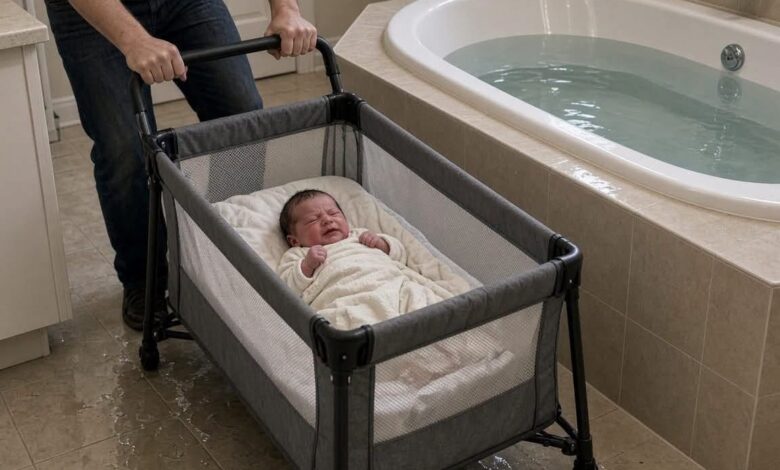
The deep bathtub.
The crib moving toward it.
The baby inside.
The packed clothes.
The secret key.
The violence when I pulled the child away.
She stopped answering him.
Later, while the baby was being examined, she told me how ordinary the relationship had seemed before that night.
Her boyfriend had been helpful after the birth.
He carried laundry.
Warmed bottles.
Bought groceries.
Told her to sleep while he handled things.
His sister helped with clothes and household chores.
Trust hadn’t arrived through grand promises.
It had been built through ordinary usefulness.
That was why the bathroom had been so difficult for her mind to accept.
The same people who knew where she stored the baby’s clean clothes had packed them.
The same man who told her to rest had apparently arranged access to her home without permission.
The same people who called themselves helpers had attacked the person holding her newborn.
“There were arguments,” she admitted.
“About what?”
“Taking him places. They thought I was too protective.”
She looked toward her son.
“I thought it was just too many adults having opinions.”
Maybe it had once been that.
But the key changed something.
A disagreement about boundaries is one thing when everyone still needs permission to cross the door.
A secretly held key means someone has decided permission is optional.
His sister later claimed she’d simply packed what she’d been told to pack and hadn’t expected anything physical to happen.
But she had grabbed my arm while I held the baby.
She had stood beside that packed tote while the crib moved toward the bath.
Her later description of her role couldn’t erase what she’d actually done.
Neither of us tried to invent a motive that night.
We didn’t know exactly why the bathtub had been filled so deeply.
We didn’t need to decide.
Motive could wait.
Safety couldn’t.
They had access to the apartment.
They had access to the newborn.
They had packed his belongings.
His crib had been moved dangerously close to deep water.
And violence followed when someone intervened.
Those facts were enough for the mother’s next decision.
Neither sibling would have access to her child again.
The locks were changed before she treated the apartment as secure.
She refused her boyfriend’s request to collect his belongings privately.
She refused to meet his sister alone to “clear up the misunderstanding.”
Then came the pressure.
He accused her of destroying his life.
His sister accused her of trusting a stranger over people who had spent months helping her.
That one hurt.
I was, after all, just the person downstairs.
They were people she’d invited into her child’s life.
Later she looked at the bandage near my temple.
“You didn’t ask me to trust you.”
I waited.
“You just grabbed the crib.”
There wasn’t anything to add.
The days afterward were quieter than that bathroom.
In some ways, they were harder.
She had to rebuild routines that had depended on people she no longer trusted.
Every hallway noise made her pause.
She checked the new lock repeatedly.
Sometimes she’d remember something kind her boyfriend had done and immediately seem ashamed.
One afternoon I finally told her, “You don’t have to pretend every good memory was fake to take what happened seriously.”
She looked at me.
“You trusted what you knew then. Now you know something else.”
That seemed to matter.
Because telling someone they should have known rarely helps them trust themselves again.
I hadn’t known either.
When I opened that bathroom door, I didn’t have the whole story.
I had three facts.
The water was deep.
The crib was moving.
The newborn was inside.
That was enough.
Eventually, workers repaired my ceiling.
They opened the damaged section, traced the overflow between floors, replaced the drywall and painted over the stain.
To them, it was ordinary water damage.
To me, it was the reason I’d gone upstairs at exactly the moment I did.
Weeks passed.
The baby’s routines became more predictable.
His mother stopped freezing every time footsteps crossed the hallway.
Her boyfriend was gone.
His sister no longer appeared carrying baby clothes.
Then one afternoon, she knocked on my door.
The baby was asleep against her shoulder.
And there was a key in her hand.
For an instant, seeing it pulled me straight back to the wet bathroom.
She noticed.
“New lock,” she said.
I nodded.
Then she held the key toward me.
“I want you to have the emergency spare.”
I didn’t take it.
“Are you sure?”
“Yes.”
I looked at the key.
No baby’s name written across the tag.
No soaked tote.
No secret arrangement.
No one deciding that permission was unnecessary.
Just a mother standing in daylight, choosing who could enter her home.
I took it.
The baby stirred.
She automatically placed one hand behind his head.
The first key had frightened her because someone had taken access without asking.
The second meant the opposite.
Permission.
Choice.
Trust.
She decided who entered her home.
She decided who held her child.
She decided what help looked like now.
Then she walked upstairs with her newborn resting safely against her chest.
I remained in my doorway with the spare key in my palm.
It looked almost identical to the one we’d found beneath the baby’s packed clothes.
But it meant something entirely different.
The first key said someone believed they didn’t need her permission.
This one existed because she had given it.
And sometimes the difference between control and trust is no bigger than that:
A closed hand taking access for itself.
Or an open one choosing to give it.