My Ex-Husband Invited Me to Christmas to Show Off His New Fiancée — Then Four Young Boys Arrived With an Unexpected Surprise..

Grace almost deleted the invitation.
She read it three times instead.
Christmas dinner. Our house. We’d really like you to come. All of you.
For eight years, Ethan’s parents had existed mostly as names she avoided saying around her sons. Now they were inviting Grace—and the four boys they’d never met—to Christmas.
She didn’t accept because she wanted revenge.
She accepted because her sons deserved to know where half of them came from.
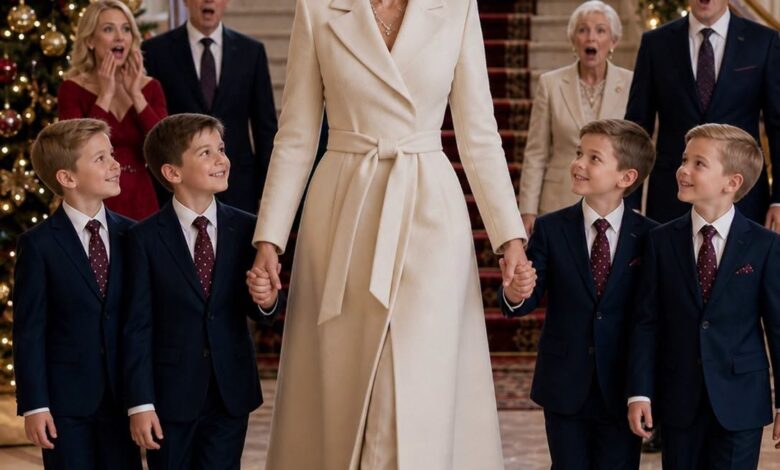
The boys were eight now: Noah, Luke, Caleb, and Owen. Four brothers born minutes apart, similar enough to make strangers stare but different enough that Grace could identify each of them by footsteps alone.
Ethan had never learned those differences.
He hadn’t been there long enough.
When Grace discovered she was carrying quadruplets, Ethan panicked. He questioned everything—the timing, the relationship, even whether the children were his.
Grace remembered his final words with painful clarity.
“I can’t build my life around something I’m not sure about.”
So he didn’t.
Grace built hers around four babies instead.
There were nights when all four cried at once.
There were mountains of diapers, medical appointments, daycare costs, secondhand clothes, and mornings when Grace couldn’t remember whether she’d slept.
But there was laughter too.
First steps.
First words.
Four kindergarten backpacks lined up by the door.
Birthday cakes with four names squeezed across the icing.
Grace never told the boys their father was dead or invented some heroic explanation for his absence.
She gave them the simplest truth she could.
“He wasn’t ready to be your dad.”
Then, eight years later, Ethan contacted her.
The invitation followed.
On Christmas afternoon, Grace parked outside his parents’ house and turned toward the back seats.
“Remember,” she said, “we can leave whenever you want.”
Caleb frowned. “Even before dessert?”
“Maybe not then.”
The boys laughed.
Grace needed that laugh.
They walked to the front door together.
Ethan opened it.
For several seconds, nobody spoke.
He had seen photographs by then, but photographs hadn’t prepared him for four boys standing on his parents’ porch wearing matching dark sweaters.
Behind him, his mother appeared.
Then his father.
Noah, always the brave one, smiled.
“Merry Christmas.”
Something happened to Ethan’s mother’s face.
Her hand flew to her mouth.
“Oh, my God.”
Four nearly identical voices answered awkwardly.
“Merry Christmas.”
She started crying.
Grace had prepared herself for suspicion.
Questions.
Coldness.
She wasn’t prepared for Ethan’s father kneeling and asking each boy his name as though committing them immediately to memory.
Dinner was uncomfortable at first.
Everyone tried too hard.
Ethan’s mother asked whether the boys wanted potatoes approximately six times.
His father kept staring at them.
Finally Owen asked, “Why do you keep looking at us?”
The older man swallowed.
“Because I’m trying to understand how I missed eight Christmases.”
Silence settled across the table.
Grace could have rescued everyone.
She didn’t.
Some truths deserved room.
Later, Ethan found her alone in the kitchen.
“Why didn’t you contact my parents?”
Grace turned toward him.
“I contacted you.”
He looked down.
“I thought—”
“I know what you thought.”
“I wasn’t sure.”
“You were sure enough to leave.”
That landed.
Grace didn’t raise her voice.
She didn’t need to.
“You didn’t ask for a test. You didn’t stay long enough to find out. You made uncertainty into an excuse and disappeared.”
Ethan gripped the counter.
“I lost eight years.”
“No.”
Grace shook her head.
“The boys lost eight years. You made a choice.”
His eyes filled.
That was when Noah walked into the kitchen looking for more pie.
He stopped.
“Are you guys fighting?”
“No,” Grace said.
Ethan wiped his face.
“We’re talking about something I did wrong.”
Noah studied him.
“Leaving us?”
Ethan looked stunned.
Grace had never hidden that truth.
“Yes.”
“Why?”
There are questions adults can avoid for years until a child asks them directly.
Ethan crouched.
“Because I was scared, and I convinced myself of something that made running away easier.”
Noah considered this.
“That was dumb.”
A broken laugh escaped Ethan.
“Yes. It was.”
Noah grabbed the pie and left.
Nothing was magically repaired.
But something had started.
After Christmas, Ethan asked Grace what came next.
“Consistency,” she said.
“What does that mean?”
“It means don’t promise them Disneyland. Learn their lives.”
So he did.
Slowly.
He learned that Caleb hated tomatoes but somehow loved ketchup.
That Luke became anxious during thunderstorms.
That Owen couldn’t sleep without reading.
That Noah pretended not to be afraid of anything and was terrified of dogs.
He learned which boy loved dinosaurs, which preferred soccer, and which two would argue for forty minutes over who got the front passenger seat someday.
He attended school events.
He called when he said he would.
When Grace established boundaries, he followed them.
When the boys were angry, he didn’t tell them to be grateful he’d returned.
And there was anger.
One afternoon Luke asked, “Why should you get to be our dad now?”
Ethan didn’t defend himself.
“I don’t automatically get to,” he said. “I have to become someone you can trust.”
Grace heard about that conversation later.
For the first time, she believed Ethan might actually understand.
Forgiveness didn’t arrive as one dramatic moment.
It came unevenly.
One boy trusted quickly.
Another held back.
Sometimes they called Ethan Dad.
Sometimes they used his name.
He learned not to react to either.
His parents became part of their lives too.
Their grandmother tried making up for eight missed Christmases in approximately three months until Grace gently told her to stop buying things.
“They need grandparents,” Grace said. “Not compensation.”
So the gifts became smaller.
The time became bigger.
That mattered more.
By the following Christmas, the boys knew exactly where to leave their shoes in their grandparents’ hallway.
There were arguments over board games, wrapping paper everywhere, and one burned tray of cookies nobody admitted responsibility for.
Nothing looked miraculous.
That was what made it beautiful.
Grace stood in the kitchen watching Ethan help Owen untangle Christmas lights.
She remembered the previous year.
Four boys standing nervously on a porch.
A grandmother covering her mouth.
A grandfather realizing he’d missed eight Christmases.
A father confronting the cost of a decision he’d once treated as temporary.
Grace didn’t regret opening the door.
That didn’t mean she’d forgotten what Ethan had done.
Protecting her sons had never required pretending the past didn’t matter.
And forgiveness didn’t mean rewriting history until nobody was responsible anymore.
Ethan had left.
Grace had stayed.
Those facts remained.
But another fact existed now.
Ethan was staying too.
Not perfectly.
Not heroically.
Just consistently.
The boys didn’t need a grand gesture.
They needed someone who remembered soccer practice.
Someone who knew Luke hated thunderstorms.
Someone who showed up when there wasn’t a camera, holiday, or dramatic reunion waiting.
That first Christmas hadn’t repaired eight lost years.
Nothing could.
Childhood doesn’t issue refunds.
But Grace finally understood that refusing to erase the past didn’t require imprisoning her children inside it.
She could protect them and still let something new grow.
Ethan could regret leaving without demanding immediate absolution.
And four boys could love their father without pretending he had never hurt them.
The invitation hadn’t delivered revenge.
It hadn’t delivered a miracle either.
It had delivered an opportunity.
Four grandchildren walked through a door and said, “Merry Christmas.”
A family looked at what had been lost.
Then, carefully, they began deciding what could still be built.
The past remained exactly where it belonged.
Behind them.
And for the first time in eight years, their future was something they were writing together.