After a devastating car accident, I was rushed to the hospital. My husband burst into my room, furious. “Enough with this act!” he shouted. “Get out of that bed. I’m not wasting another dollar on you!” He grabbed my arm and tried to pull me off the mattress. When I struggled to resist, he drove both fi:sts into my stomach. What happened next changed everything.

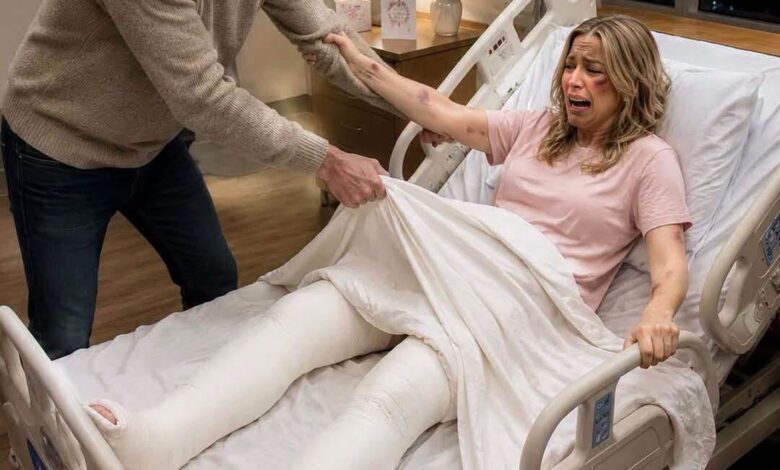
Twenty-one days after a car crash shattered both her legs, Rebecca Walker finally learned which injury hurt the most.
It wasn’t the fractured ribs.
It wasn’t the stitches hidden beneath her hair or the bruises spreading across her body.
It was watching her husband stand at the foot of her hospital bed and look at her as though surviving had become too expensive.
“Enough of this drama.”
Rebecca stared at Caleb.
For three weeks, she had learned the rhythm of that room by heart. The monitor beeped beside her. The air vent clicked overhead. Fluorescent lights hummed through sleepless nights while heavy plaster casts imprisoned both legs from thigh to foot.
The accident itself remained fragmented in her memory—broken glass, burning pavement, someone telling her not to move, sirens growing louder.
She remembered asking for Caleb.
Of course she had.
When your world breaks apart, you reach for the person you believe will help hold the pieces together.
But Caleb had barely visited.
Once, he brought their thirteen-year-old daughter, Emma, who sat beside Rebecca and held her hand for almost an hour.
Another time, Caleb arrived carrying insurance paperwork.
No flowers.
No comfortable socks.
Not even the lip balm Rebecca had specifically asked him to bring.
Only bills.
“How much longer are they keeping you here?” he’d demanded.
Now, on the twenty-first day, Caleb had arrived alone.
“Get up,” he said. “We’re leaving.”
Rebecca glanced at her casts.
“What?”
“You heard me.”
“Caleb, I can’t walk.”
“Don’t start.”
“My legs are broken.”
“I know what the doctors said.”
He leaned across the bedrail, mint gum on his breath.
“I also know what this place is charging us. I’m done wasting money on this performance.”
Performance.
Rebecca looked at the IV taped to her swollen hand.
For eleven years, Caleb had possessed an extraordinary talent for turning her pain into an inconvenience for him.
He hadn’t seemed cruel when they first married.
He had seemed practical.
Responsible.
Reliable.
After Emma was born, Caleb suggested Rebecca leave accounting.
“One of us should actually raise our daughter.”
The words had sounded reasonable then.
So Rebecca surrendered her career.
She packed lunches before sunrise, balanced household accounts at the kitchen table, answered school emails, attended parent conferences, scheduled appointments, stretched grocery money, and absorbed Caleb’s moods before they could reach Emma.
Gradually, gratitude became expectation.
Expectation became entitlement.
And Rebecca became invisible.
“I gave up everything for this family,” she whispered. “You’re my husband. You’re supposed to help me.”
Caleb stared at her.
“Help you?”
His mouth twisted.
“You’re a burden.”
Something inside Rebecca went strangely quiet.
Caleb ripped the blanket from her body.
Then he grabbed her arm.
“Caleb, stop.”
He pulled.
Pain tore through Rebecca’s ribs as her casts scraped across the mattress.
The monitor accelerated.
Beep-beep-beep-beep.
“Get out of this bed.”
“I can’t!”
“I’m not paying for a wife who can’t even make herself useful.”
Rebecca’s fingers wrapped around the metal rail.
For eleven years, she had survived Caleb by knowing when not to resist.
But now she thought of Emma.
And for perhaps the first time in their marriage, Rebecca stopped asking herself what would calm Caleb down.
She asked herself what she wanted.
“No.”
Caleb froze.
“What?”
Rebecca tightened her grip.
“No.”
His fists slammed into her stomach.
Pain exploded through her.
The room disappeared into white light as the breath vanished from her lungs. She folded forward, screaming, while the monitor erupted into an alarm.
Caleb leaned over her.
“You don’t get to talk back to me.”
His arm rose again.
Then the door opened.
A nurse in navy scrubs stopped dead.
Behind her stood the charge nurse.
Everyone froze except the monitor.
Caleb stepped backward.
“She was trying to get out of bed,” he said instantly. “I was helping her.”
The nurse looked at Rebecca’s casts.
Then at Rebecca.
“Mrs. Walker?”
Caleb interrupted.
“My wife is medicated. She’s confused.”
There it was.
The old escape route.
Rebecca could make this disappear.
She could say it was a misunderstanding.
She could protect him again.
Instead, she looked at the nurse.
“He hit me.”
Caleb’s face changed.
“Rebecca.”
“Twice.”
Security arrived minutes later.
Caleb argued the entire way down the corridor.
“You’ll regret this when the bills come!”
Rebecca closed her eyes.
For once, she didn’t answer.
Doctors examined her again. Nurses photographed and documented her injuries. A police officer took her statement. Caleb was removed from the visitor list.
Then a social worker pulled a chair beside Rebecca’s bed.
“Do you feel safe?”
Rebecca almost answered automatically.
“Yes.”
The word left her mouth before she stopped.
She swallowed.
“No.”
Her voice shook.
“Not with him.”
That evening, she called Emma.
“Mom? Dad said you were being dramatic.”
Rebecca closed her eyes.
That word again.
“Emma, listen carefully. I’m safe. But your father isn’t allowed to visit me anymore.”
Silence.
“What happened?”
“He hurt me.”
Emma began crying.
Then she whispered something that changed everything.
“He yells when you’re not home.”
Rebecca’s chest tightened.
“At you?”
“Sometimes.”
Emma hesitated.
“He gets mad at your chair. At the kitchen. At the bills. At me when I ask when you’re coming home.”
Rebecca covered her mouth.
For years, she had believed absorbing Caleb’s anger protected Emma.
The accident had proved otherwise.
Caleb hadn’t suddenly become cruel.
Rebecca had simply stopped being there to stand between him and their daughter.
The next morning, she signed every form placed before her.
She removed Caleb as her emergency contact.
She named her sister instead.
She requested the visitor logs, medical records, photographs, nursing notes, and incident report.
Her hands shook through every signature.
But she signed.
Recovery was brutal.
Physical therapy sometimes left her crying from exhaustion. Learning to stand felt impossible. Learning to walk seemed worse.
But every step carried her farther from the woman who had believed survival meant keeping Caleb happy.
Months later, Rebecca entered family court using a walker.
Her sister stood beside her.
Caleb sat across the room with his attorney.
He looked strangely ordinary.
His lawyer described the hospital incident as a misunderstanding.
The judge had something Caleb hadn’t faced during eleven years of marriage.
Records.
The nurses’ statements.
The security report.
The visitor log.
Rebecca’s injuries.
Her statement.
Documentation couldn’t be intimidated into silence.
A temporary protective order was granted. Caleb’s contact with Emma was restricted, and future communication would take place through approved legal channels.
Rebecca didn’t feel victorious.
She felt exhausted.
Outside the courtroom, Emma waited with Rebecca’s sister and held out a vending-machine coffee.
“I got you one.”
Rebecca tasted it and nearly laughed.
It was terrible.
Emma watched her nervously.
“Are we going to be okay?”
Rebecca could have promised her everything would be perfect.
She didn’t.
“We’re going to be honest,” she said. “That’s where okay starts.”
Nearly a year after the crash, Rebecca drove herself to Emma’s school.
Her legs still hurt when rain was coming, but she was walking independently again.
She had also returned to accounting.
Her first paycheck wasn’t enormous, yet she kept the deposit confirmation inside her planner because it represented something money couldn’t measure.
Choice.
Emma emerged from school and climbed into the passenger seat.
“You know what?” she said.
“What?”
“You seem different.”
Rebecca smiled.
“Different good or different weird?”
Emma considered this.
“Both.”
Rebecca laughed.
As they drove home, they passed the hospital.
Emma pointed toward it.
“Do you hate that place?”
Rebecca looked through the windshield.
She remembered antiseptic.
Fluorescent lights.
Broken legs.
Caleb’s hands.
But she also remembered a door opening.
A nurse refusing to look away.
A social worker asking the right question.
A pen trembling in her hand as she removed Caleb’s name from her paperwork.
“No,” Rebecca said.
“Why?”
She thought carefully before answering.
“Because that’s where I finally learned what safe means.”
Emma reached across the console and squeezed her hand.
Rebecca squeezed back.
For years, she had confused silence with peace, sacrifice with love, and endurance with strength.
Now she understood the difference.
Love didn’t require disappearing.
Peace didn’t require fear.
And strength wasn’t always standing tall.
Sometimes strength was lying helpless in a hospital bed, unable to walk, while the person who had controlled you for years demanded obedience.
Sometimes freedom began before you could even stand.
Rebecca had taken the first step toward hers with two broken legs, both hands gripping a hospital rail, and one quiet word Caleb had never expected to hear.
“No.”