After My Husband Left Me Lying on the Kitchen Floor, Barely Able to Breathe, Our Five-Year-Old Son Grabbed My Phone and Called the One Man His Father Never Wanted Near Us.

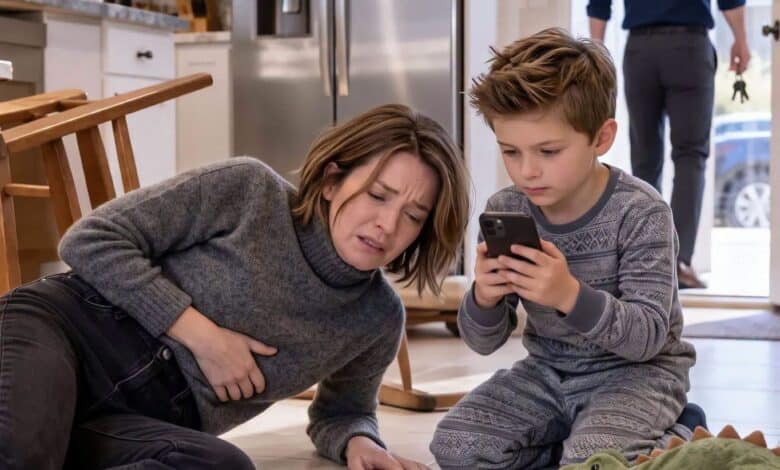
“Grandpa, come quickly. Mommy needs help.”
Those six words ended seven years of silence.
Minutes later, my husband came back through the front door, saw our five-year-old son clutching my phone, and demanded, “Who did you call?”
Before our son could answer, my father’s voice came through the speaker.
“Me.”
Julian froze.
Only minutes earlier, he had left me lying on the kitchen floor, barely able to breathe.
The pain in my ribs was so sharp that every breath felt like glass moving beneath my skin. An overturned dining chair lay beside me. My phone had slid underneath it. The fluorescent light overhead hummed steadily, absurdly normal against the chaos.
What I remember most, though, is Noah.
Our five-year-old stood in the hallway wearing dinosaur pajamas.
He didn’t cry.
He simply watched his father grab my car keys and leave.
“Clean yourself up before I get back,” Julian said. Then he looked at Noah. “And teach that kid not to make a scene.”
The door slammed.
His truck roared away.
Noah dropped his stuffed dinosaur and ran to me.
“Mommy?”
“I’m okay.”
The lie came naturally.
I had practiced it for years.
I slipped.
Julian is stressed.
We argued.
It was an accident.
That night, the argument had started over two hundred dollars.
For months, I had been quietly putting money into a private account Julian didn’t know existed.
Five dollars left from groceries.
Twenty from a birthday card.
Small amounts whenever I could hide them without attracting attention.
Two hundred dollars wasn’t enough to start over.
But it was enough to imagine that starting over might someday be possible.
At 8:17 that evening, Julian saw the banking app open on my phone.
“What is this?”
His voice dropped into that low, controlled tone that frightened me more than shouting.
“Nothing.”
“Do you have a secret account, Evelyn?”
I reached for the phone.
Then came the chair crashing over.
My back hitting the kitchen island.
His hand gripping my arm.
And finally the floor.
Julian stood above me.
“Are you planning to leave me?”
“No.”
I lied because Noah was watching.
Julian glanced toward our son.
For one second, I hoped seeing him there would make Julian ashamed.
Instead, his expression changed into something cold and calculating.
He wasn’t wondering what Noah felt.
He was wondering how much Noah had seen.
Then Julian left.
Now Noah crawled beneath the overturned chair and retrieved my phone.
“Honey, don’t—”
He already knew my passcode.
His little finger scrolled through my contacts until he found a sailboat emoji beside one name.
Dad.
Noah looked at me.
“This is what Grandpa is for.”
He pressed call.
My father answered immediately.
“Evelyn?”
Noah swallowed hard.
“Grandpa, come fast. Mommy can’t breathe.”
My father’s voice changed.
Arthur Vance had spent more than thirty years managing commercial shipping operations around the Great Lakes. He had handled fires, crane failures, industrial injuries, and emergencies where panic made everything worse.
He went instantly calm.
“Buddy, look at Mommy. Is she bleeding?”
“No.”
“Can she talk?”
“A little.”
“Put the phone beside her.”
Noah placed it on the linoleum.
“Evelyn,” Dad said. “Don’t move. If Julian did this, tap the screen once.”
My hand shook.
For seven years, I had hidden bruises and defended my marriage because telling the truth meant admitting there was nothing left to defend.
I tapped once.
Silence.
Then Dad said, “Noah, unlock the front door and stay beside your mother. I’m calling 911. I’m coming.”
Noah ran.
That was when I heard the truck.
Julian was back.
His footsteps came quickly down the hallway.
He entered the kitchen, saw me, then noticed Noah holding my phone.
“Who did you call?”
Noah backed against me.
Julian stepped closer.
“I asked you a question.”
Then Dad’s voice filled the kitchen.
“Me.”
Julian stopped.
“Arthur, listen. You don’t understand—”
“I understand my daughter can’t breathe.”
“She fell.”
“Evelyn already confirmed what happened.”
Sirens sounded faintly in the distance.
Julian’s face changed.
“You called the police?”
“I called everyone who needed to know.”
Julian moved toward Noah.
“Give me the phone.”
“No.”
It was the smallest voice in the room.
And somehow the strongest.
Headlights swept across the windows.
Dad’s truck.
Seconds later, he entered.
He didn’t touch Julian.
He didn’t threaten him.
He came directly to me and dropped to his knees.
“I’m here.”
Noah threw himself against him.
Julian immediately began talking.
“She tripped. She was hysterical. She fell over the chair.”
Dad stood between us.
“You should stop talking.”
Police and paramedics arrived moments later.
Julian transformed.
His voice softened.
His posture relaxed.
“Officer, thank God. My wife has been unstable lately.”
A paramedic knelt beside me.
“Did someone do this to you?”
The familiar lie rose automatically.
Then Noah took my hand.
“Daddy hurt Mommy.”
Everything stopped.
Julian turned.
“Buddy, you don’t understand.”
“I saw you.”
Three words.
Seven years of carefully constructed lies collapsed beneath them.
The officer stepped between Julian and us.
The paramedic asked me again.
“Did your husband assault you?”
I looked at Noah.
Then at Dad.
“Yes.”
At the hospital, X-rays showed three fractured ribs.
Doctors documented my bruises.
Police photographed the kitchen, the overturned chair, and Noah’s stuffed dinosaur lying near the wall.
For the first time, the truth existed somewhere outside my own memory.
The next morning, a detective came to my room.
I told her everything.
The financial control.
The monitored receipts.
The restricted visits.
The phone checks.
The secret account.
Investigators also discovered that Julian had tried to access that account shortly after leaving the house.
Later, prosecutors uncovered messages he had sent describing me as mentally unstable and asking about obtaining financial control over a supposedly incapacitated spouse.
The two hundred dollars had never really been about money.
It was about control.
Months later, I sat in court while Julian appeared in a tailored suit looking exactly like the respectable man everyone believed him to be.
His attorney asked the question I had feared most.
“You stayed for seven years?”
I looked toward Julian.
Then answered.
“Fear doesn’t always look like running away. Sometimes it looks like staying quiet because you’re trying to keep your child safe until you can see a way out.”
The courtroom became still.
Julian was ultimately convicted, and protective orders followed.
But the verdict was not the moment that changed my life.
The change had already happened on our kitchen floor.
Afterward, Noah began therapy.
He drew the same things repeatedly.
Dinosaurs.
Phones.
Houses.
And a large sailboat.
One afternoon, his therapist asked why the boat appeared in every picture.
Noah answered simply.
“Because that means Grandpa is coming.”
The sailboat had been the symbol beside Dad’s name on my phone.
To Noah, it meant safety.
In the months that followed, Dad helped us rebuild without once asking why I hadn’t left sooner.
He changed locks.
Drove Noah to school.
Sat with me when truck engines outside still made my heart race.
Eventually, Noah and I moved into a smaller house with sunlight in every room and a fenced backyard.
No one checked my receipts.
No one monitored my location.
No one counted the miles on my car.
One afternoon, Noah looked up from his toys.
“Mommy?”
“Yes?”
“Was I brave that night?”
I sat beside him.
“You were incredibly brave.”
He frowned.
“But I was scared.”
I took his hand.
“You can be scared and brave at the same time.”
He thought about that, then smiled and returned to his dinosaurs.
I watched him play and remembered his tiny hands reaching beneath that chair for my phone.
For seven years, I had believed Julian’s abuse was a locked cage.
But cages only work while you believe every door is closed.
That night, my five-year-old found one I had forgotten existed.
He didn’t save us because he wasn’t afraid.
He saved us because fear didn’t stop him from telling someone the truth.
And sometimes that is where freedom begins.
Not with strength.
Not with certainty.
Just with one frightened voice saying:
“Grandpa, come quickly. Mommy needs help.”