An 84-Year-Old Veteran Tried to Sell His Only Watch for a $62 Bus Ticket — Then Forty Bikers Learned Whose Name Was Engraved on the Back

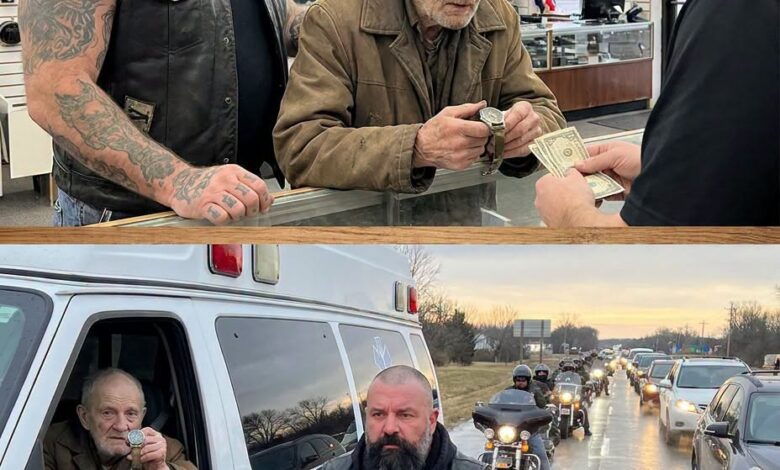
Amos Bell did not trust us at first.
I couldn’t blame him.
Forty motorcycles gathered around one old man can look like protection or trouble depending on what kind of life that man has lived.
Amos had lived quietly.
Army first. Then a machine shop outside Springfield. Later, boiler maintenance at a public high school until arthritis stiffened his hands too badly for the valves.
Men like Amos usually learned one thing early.
Help always seemed to come with paperwork, pity, or a price.
He wanted none of them.
Before we left the bus station, Donna made him sit inside the transport van while she checked his blood pressure and medication.
“Two bottles?” she asked.
“One for pain. One for nausea.”
“What about the others?”
“There are no others.”
“Any allergies?”
“People who ask too many questions.”
Donna nodded thoughtfully.
“Good. Sarcasm means your airway is fine.”
Amos looked at me.
“Is everybody in this club like her?”
“Worse.”
That nearly earned a smile.
The Iron Lantern Riders weren’t what people imagined when they saw patched leather and a line of loud bikes.
Most of us had arrived after something in our lives collapsed.
Marriage.
War.
Prison.
Alcohol.
Family.
For me, it had been my son.
Danny was nineteen when a drunk driver crossed the centerline outside Joplin. For two years after that, I drank until memories blurred at the edges. Then one night I broke a stranger’s jaw because he touched my shoulder at the wrong moment.
Eleven months in county lockup taught me many things.
The hardest was that regret does not undo damage.
After my release, Grady gave me a place in the club workshop.
No lecture.
No judgment.
Just a wrench.
That was twenty-three years ago.
The Iron Lanterns never claimed to rescue anyone.
We simply showed up.
And that morning, Amos began to understand what showing up looked like.
Grady rode point while I stayed near the passenger side of the van. Riders rotated as blockers through lane changes, the rest staggered behind us. Donna stayed with Amos for the first hour.
When I switched into the van near Rolla, he was watching motorcycles through the window.
“You all follow the one in front?”
“Mostly.”
“What happens if someone breaks formation?”
“We correct it at the next stop.”
“Loudly?”
“Depends how stupid it was.”
He nodded approvingly.
The field watch rested on his knee.
Up close, it looked even older. Scratched crystal. Dented steel. A repaired strap. The minute hand jumped slightly before settling.
“You keep staring at it,” Amos said.
“I keep wondering why you were willing to sell it.”
“I wasn’t selling the years. Only the metal.”
“That isn’t how you held it.”
His eyes shifted toward the window.
Conversation over.
At our first fuel stop, Jesse Mercer kept staring at him.
Jesse was thirty-four, a welder, Army National Guard, two deployments. Quiet man. Strong shoulders. He carried a folded photograph inside his leather cut.
His grandfather.
A young soldier beside a helicopter in 1969.
Amos noticed him.
“Do I owe that boy money?”
“Not unless you borrowed it before he was born.”
“He keeps looking at me.”
“So do you.”
Amos lifted his coffee. His hand trembled hard enough to rattle the lid.
I reached for the cup.
He pulled it away.
“Don’t make me helpless before I am.”
The words cut sharp.
I withdrew my hand.
“All right.”
After a moment, he set the cup down.
“My apologies.”
“None needed.”
He studied me.
“You lost a son.”
I hadn’t told him.
Donna must have.
“Long time ago.”
“No,” Amos said. “It happened a long time ago. That is different.”
No pity.
That was why I answered.
“He would’ve been forty-two.”
“What was his name?”
“Danny.”
Amos nodded once.
“Every name deserves someone who still says it.”
Then he wound the watch.
Tiny clicks.
His fingers slipped.
For one second, I saw an engraving beneath his thumb.
M-E-R.
I glanced toward Jesse Mercer.
Then Amos closed his hand around the watch.
The weather broke east of St. Louis.
Rain hammered the interstate until the motorcycles behind us became blurred red lights. Wind slapped the van hard enough to shift us sideways.
Donna ordered us off the road.
We found a truck stop surrounded by flooded fields.
Riders rolled in one at a time.
Thirty-nine.
Then forty.
Amos stood in the van doorway.
“They should go home.”
“They chose where they’re going.”
“This isn’t their business.”
“You made it their business when you nearly traded half a lifetime for bus fare.”
His face tightened.
I had guessed wrong about one thing.
That watch had not been his for fifty-seven years.
It had been longer.
Inside the van, Donna checked him again.
His pulse was irregular.
Pain worsening.
“You need a hospital.”
“No.”
“That is not optional.”
Amos looked at me.
“You bought me a ticket, Mr. Dawson. You did not buy command.”
There it was.
Old Army steel.
I sat across from him while rain drummed overhead.
“What’s really waiting in Bellweather?”
“A house.”
“There are houses everywhere.”
“Not that one.”
He finally told me.
Coal-miner father.
Mother who sewed for neighbors.
A bedroom with a roof leak.
A pear tree outside the kitchen that never grew decent fruit.
“I want to know if it’s still there.”
We called his doctor.
No call, no Kentucky.
Amos hated me for ten minutes.
Then agreed.
The doctor warned us to monitor him closely.
We continued.
Eleven riders turned back for work and family.
Every one shook Amos’s hand before leaving.
“You came farther than I had any right to expect,” he told each of them.
Near dusk, we crossed the Mississippi beneath a red strip of sky.
Amos watched the river.
“In 1968, I crossed a river at night with a man who couldn’t swim.”
“Vietnam?”
He looked at me.
“You guessed?”
“You fold clothes like military bedding and treat pain as an insult.”
He almost smiled.
“His name was Tommy.”
Then his hand found the watch again.
“Not yet.”
That night, outside Mount Vernon, Amos collapsed.
The watch fell beneath the motel bed.
Donna shouted for an ambulance.
Jesse dropped to his knees and reached underneath.
When he brought the watch out, he wiped the dust away.
Then froze.
The engraving read:
THOMAS E. MERCER — 1969
Jesse stopped breathing.
He opened his vest and pulled out the old photograph.
Same name.
Same face.
“My grandfather,” he whispered.
Amos opened his eyes.
For the first time since I met him, the old man cried.
Thomas Mercer had given Amos that watch in Vietnam.
They served together.
Thomas was killed after going back for a wounded man.
Amos was with him.
He held him when he died.
Thomas made Amos promise to keep the watch.
Not return it.
Use it.
Wind it.
Live.
“Your grandfather said nobody survives grief by staring at the clock waiting for time to go backward,” Amos told Jesse later.
For fifty-seven years, Amos obeyed.
Badly sometimes.
But he obeyed.
He wore the watch through funerals, factory shifts, marriage, illness, and the slow disappearance of nearly everyone who remembered him young.
He almost sold it for forty dollars.
Jesse’s father, David, had grown up believing Thomas died alone.
He hadn’t.
When Jesse called him from the road, David drove out to meet us.
Amos apologized for never returning.
David didn’t excuse him.
He did something harder.
He listened.
Then he hugged him.
The rest of the trip changed after that.
Jesse rode in the van.
He recorded Amos telling stories.
Thomas hated canned peas.
Cheated terribly at cards.
Sang only first verses.
Laughed loud enough to calm scared men before patrol.
And before every dangerous moment, Thomas tapped the watch twice.
“One minute at a time, boys.”
That was all anybody got.
When we finally reached Bellweather, Amos barely recognized it.
Buildings gone.
Church burned.
School demolished.
But the road to his childhood property remained.
We walked the last half mile through wet grass.
Jesse held one arm.
David held the other.
Then the house appeared.
Half collapsed.
Roof caved in.
Windows empty.
Amos stopped breathing for a moment.
And then Jesse pointed.
Beside the ruined kitchen wall stood the pear tree.
Bent.
Half dead.
Still alive.
Three green pears clung to the branches.
Amos laughed.
“That miserable tree.”
We placed a folding chair in the yard.
He sat there for twenty minutes.
No speeches.
No prayer.
Just an old man watching the sunlight move across the remains of the place where his life began.
Before leaving, Amos picked one pear.
“Enough,” he said.
He lived two more months.
We moved him near Grady.
Someone visited every day.
Jesse recorded twenty-three hours of stories.
David came from Kentucky.
The pear ripened in a paper bag.
When we finally cut it open, it was hard and sour.
Amos chewed slowly.
“Best one that tree ever made.”
He died on a Sunday morning.
Thirty-eight motorcycles were outside.
He heard them.
“How many?”
“Thirty-eight.”
“Couldn’t get forty?”
“Mack’s coming.”
Amos waited.
At 6:43, Mack’s engine stopped outside.
Amos exhaled.
He never inhaled again.
The watch went to Jesse.
The will contained one instruction.
Do not put it in a box.
Wind it.
Months later, Jesse rode back to Bellweather.
He expected to go alone.
Forty motorcycles were waiting.
We rebuilt what little remained of the porch and planted a new pear tree beside the old one.
A brass marker went on the beam.
THOMAS MERCER, 1945–1969.
AMOS BELL, 1942–2026.
Jesse wore the watch while he worked.
He refused to polish out the scratches.
“It isn’t supposed to look new,” he said.
“Neither are we.”
Inside Amos’s canvas bag, we eventually found sixty-two dollars marked with my name.
The exact money I had paid at the pawnshop.
I never spent it.
Those bills now hang framed in our clubhouse beside a bus timetable, a route map, and the photograph of Thomas Mercer.
New members always ask why sixty-two dollars deserves a frame.
We tell them the truth.
It once bought nine hundred kilometers.
Forty motorcycles.
Fifty-seven years of memories.
A father returned to his son.
A soldier returned to his family.
And one old man enough time to sit beneath a dying pear tree and realize that coming home late was still coming home.
Jesse still taps the watch twice before every long ride.
One minute at a time.
That is all anybody gets.