At 15, My Childhood Sweetheart Promised Me 60 Sunflowers on My 60th Birthday – He Passed Away That Year, but 45 Years Later, They Appeared on My Porch with a Box That Made Me Shake

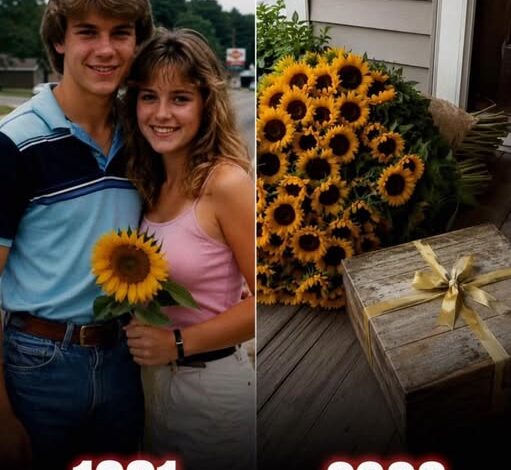
The morning I turned sixty, someone left sixty sunflowers on my porch.
For several minutes, I simply stood there staring at them.
Then I saw the envelope tucked between the stems.
My name was written across it in handwriting I hadn’t seen in twenty-seven years.
Danny’s.
My knees nearly gave out.
Danny had been dead for twenty-seven years.
There are losses that become memories.
And then there are losses that divide your life into a before and an after.
Danny was mine.
We met when I was twenty-six.
He wasn’t particularly impressive on paper. He didn’t have much money. His car made an alarming noise whenever he turned left, and he lived in an apartment where the kitchen table doubled as his desk and laundry-folding station.
But he made me laugh.
More importantly, he made me feel safe.
I’d dated men who brought expensive flowers after arguments.
Danny brought one sunflower for no reason.
The first time, I laughed.
“Why a sunflower?”
“Roses look like they’re trying too hard.”
“That’s your romantic explanation?”
“No.”
He handed it to me.
“Sunflowers always look like they’re absolutely certain the light is coming back.”
I rolled my eyes.
But I kept the flower until the petals fell off.
After that, sunflowers became ours.
One on my birthday.
One when I got promoted.
Three when we moved in together because, according to Danny, “Moving deserves more flowers than aging.”
Then he got sick.
Cancer doesn’t care whether you’ve finally found the person you imagined growing old beside.
Within fourteen months, the strongest man I knew had become someone I was helping walk to the bathroom.
He was thirty-three when he died.
I was thirty-one.
Two weeks before his death, I was sitting beside his hospital bed when he suddenly asked, “What do you think you’ll be like at sixty?”
I stared at him.
“What kind of question is that?”
“Answer.”
“Old.”
He smiled.
“Sixty isn’t old.”
“It sounds old when you’re twenty-nine years away from it.”
He thought for a moment.
“I think you’ll still be beautiful.”
“You’re medicated.”
“I think you’ll still complain when restaurants make the music too loud.”
“Definitely medicated.”
“And I think someone should bring you sixty sunflowers.”
I squeezed his hand.
“You can.”
Something changed in his eyes.
We both understood what I’d said.
He wouldn’t.
Danny lifted my hand and kissed my fingers.
“Maybe I will.”
He died twelve days later.
For years afterward, birthdays were difficult.
Eventually, I learned how to live around the grief.
I remarried at thirty-eight.
That marriage lasted fourteen years.
My husband wasn’t cruel.
Sometimes I think that would have made leaving easier.
He was simply careless with me.
He lied.
Then apologized.
Then lied differently.
When I discovered the affair, he told me our marriage had become “emotionally exhausting.”
For months, I wondered whether I had caused it.
Maybe I’d asked too many questions.
Maybe I’d expected too much.
Maybe I wasn’t affectionate enough.
Maybe I was too independent.
Divorce has a strange way of turning betrayal into an investigation of your own shortcomings.
Afterward came another relationship.
Then another.
Nothing catastrophic.
Just enough disappointment to teach me the wrong lesson.
That perhaps I was difficult to love.
By fifty-nine, I had stopped dating.
I told everyone I preferred being alone.
Mostly, that was true.
My children were grown. I had friends. I traveled occasionally. I gardened badly and cooked well.
My life wasn’t empty.
But there was a room inside me I had quietly locked.
Then I turned sixty.
And there were sixty sunflowers on my porch.
I picked up the envelope.
My hands were shaking so badly that I tore one corner opening it.
Inside was a single piece of paper.
The handwriting was Danny’s.
For your sixtieth.
I covered my mouth.
Underneath, he had written:
I told you the light would come back.
I sat down right there on the porch.
I don’t know how long I cried.
Eventually, I heard a car door close.
A man was walking toward me.
Older.
Gray-haired.
Familiar.
“Michael?”
Danny’s younger brother stopped at the bottom of the steps.
“Happy birthday.”
I stared at him.
“You did this?”
He nodded.
“How?”
Michael sat beside me.
“A few months before Danny died, he gave me an envelope.”
I looked at the flowers.
“He planned this?”
“Very carefully.”
Michael smiled.
“He made me write everything down because he was convinced I’d forget.”
Then he pulled an old folded sheet of paper from his jacket.
Danny’s handwriting covered it.
My full name.
My birthday.
My address at the time.
Then, heavily underlined:
60TH BIRTHDAY — 60 SUNFLOWERS.
I laughed while crying.
“That’s ridiculous.”
“That sounds like him.”
“It does.”
Michael became quiet.
“He made me promise.”
“For twenty-seven years?”
“He didn’t ask me to think about it every day. He just asked me not to forget.”
“How did you find me?”
“Your daughter.”
Of course.
That explained the suspicious birthday questions she’d been asking.
I looked down at Danny’s note.
Twenty-seven years.
He had known he wouldn’t see my fortieth birthday.
My fiftieth.
My sixtieth.
And somewhere near the end of his life, while confronting everything he was about to lose, he had spent part of his remaining strength imagining a morning I hadn’t reached yet.
That realization broke me in a completely different way.
“There’s something else,” Michael said.
He handed me another envelope.
This one was sealed.
On the front:
Only when she’s sixty.
I opened it carefully.
Inside was a longer note.
Danny had written:
If Michael actually remembered this, I’m impressed.
I laughed immediately.
Then I continued.
He wrote that he hoped I had lived.
Really lived.
He hoped I’d traveled somewhere that frightened me.
He hoped I’d danced badly.
He hoped I’d eaten expensive desserts without checking the price first.
And then came the sentence that stopped me.
Most of all, I hope nobody ever convinced you that loving you was difficult.
I read it again.
Then again.
Something inside me seemed to come loose.
Because people had convinced me of exactly that.
Or perhaps I’d convinced myself.
Every failed relationship had become another piece of evidence.
Too emotional.
Too independent.
Too demanding.
Too sensitive.
Too much.
Not enough.
I had spent years adjusting myself to make other people comfortable.
I apologized before asking questions.
I lowered expectations so nobody could disappoint me.
I called neglect “giving someone space.”
I called dishonesty “complicated.”
I called loneliness “independence.”
And here was a letter from a man who had written my sixtieth birthday into his final months because loving me had never felt like an inconvenience to him.
It had felt like something worth planning for.
Michael touched my shoulder.
“He loved you very much.”
“I know.”
For the first time in years, I didn’t say it sadly.
I simply knew.
My children arrived later that morning.
Then friends.
Someone brought cake.
Someone else brought champagne.
The sunflowers filled almost every vase I owned, and there were still too many.
So I began giving them away.
One to my daughter.
One to my son.
Several to friends.
One to the neighbor who had checked on me after my divorce.
One to the woman across the street who had recently lost her husband.
“What’s the occasion?” she asked.
“My birthday.”
She smiled.
“Then shouldn’t you keep them?”
I looked at the flower in her hand.
“I already got what I needed.”
That evening, after everyone left, the house became quiet again.
Petals and wrapping paper were scattered across the kitchen.
Empty glasses covered the table.
I carried the final sunflower upstairs and placed it in a small glass beside my bedroom window.
Then I reread Danny’s letter.
I had always believed my life had two parts.
Before Danny died.
And after.
But sitting there at sixty, I realized there was another part waiting for me.
The part where I stopped treating other people’s inability to love me properly as evidence that something was wrong with me.
Love doesn’t require you to disappear so somebody else can remain comfortable.
It doesn’t make you earn honesty.
It doesn’t repeatedly injure you and then complain about your reaction.
Real love can be imperfect.
People can make mistakes.
Relationships can fail.
But love should never require you to surrender your dignity just to keep someone beside you.
I wish I’d understood that sooner.
Maybe Danny knew I would eventually need reminding.
Or maybe he simply wanted to make an outrageous romantic gesture twenty-seven years late.
Either way, he succeeded.
Before bed, I stood beside the window.
The sunflower caught the last orange light of the evening.
For most of my life, I had remembered Danny’s promise as something tragic.
“Maybe I will.”
For twenty-seven years, I thought death had made that promise impossible.
I was wrong.
The flowers arrived.
The message arrived.
And somehow, so did the woman I had spent years trying to find again.
I touched one yellow petal.
Then I whispered the sentence I finally believed.
“I was never hard to love.”
The room was quiet.
No miracle happened.
No voice answered.
I didn’t need one.
Because Danny’s final gift wasn’t really sixty sunflowers.
It was the realization that I had spent too many years measuring my worth by people who didn’t know how to hold it.
The flowers would eventually wilt.
The petals would fall.
But the lesson had arrived exactly when I needed it.
Danny’s promise hadn’t returned to pull me backward.
It had come back to release me.
And at sixty years old, with one sunflower glowing in the fading light, I finally stopped asking whether I had always been worthy of love.
I started living like I knew I was.