The moment my granddaughter picked up the passport, the room stopped looking like the aftermath of a fight.
It started looking like a plan.
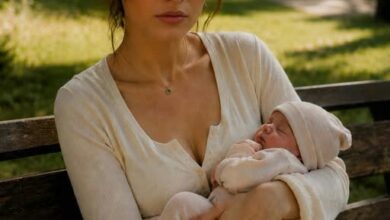
She still had her newborn pressed against her chest when she bent toward the nursery floor. One arm never loosened around the baby. With the other, she reached for the small passport lying beside a printed flight itinerary.
A few feet away, an open travel bag sat packed with tiny clothes.
Near it lay the heavy bedside lamp I had knocked from her husband’s hands.
Nothing in that room felt ordinary anymore.
Not the bag.
Not the passport.
Not the itinerary.
And certainly not the lamp.
My granddaughter lifted the passport and held it tightly.
She did not place it in the bag.
She did not leave it where it had fallen.
She kept it.
That simple movement changed everything.
Minutes earlier, we had been trying to understand an act of violence.
Now we were looking at preparation.
I was eighty-one years old, with blood drying along my cheek where her husband had struck me, but even through the pain I could see the same conclusion forming in her face.
His mother had not merely been standing in the nursery during a chaotic confrontation.
She had been packing.
The baby’s clothes were already inside the travel bag.
The newborn’s passport was out.
A flight was scheduled for that night.
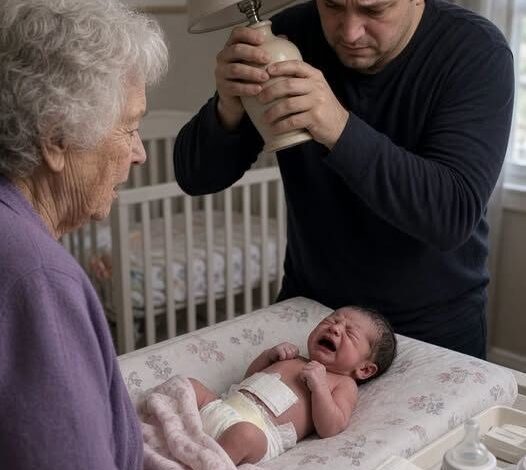
And while all of this was happening, my great-granddaughter had been lying beneath a loose abdominal dressing while her father stood over her with a heavy lamp raised above the bandaged area.
There are moments when the mind tries desperately to protect itself from what the eyes already understand.
You search for another explanation.
A kinder one.
A less frightening one.
I had done exactly that when I first entered the nursery.
I remember the smell before anything else.
Formula.
Antiseptic.
Something sour underneath it.
There were bottles on the dresser, loose gauze near the changing table, and a blanket partly pulled from the crib.
The travel bag was open.
His mother was putting baby clothes inside.
Those details should have stopped me.
They didn’t.
The lamp did.
My granddaughter’s husband stood beside the crib holding the heavy bedside lamp above the newborn.
I saw the base.
I saw the dressing on the baby’s abdomen.
I saw how close he was.
I did not wait for an explanation.
I moved.
At eighty-one, your mind often reaches a destination before your body does.
That day, somehow, mine kept up.
I grabbed the lamp before it could come down.
With my other arm, I pulled the newborn toward my chest.
Then I shoved the lamp away.
It hit the carpet.
The baby did not.
For half a second, that was the only thing that mattered.
Then he hit me.
His hand struck the side of my face hard enough to split the skin near my cheek and send me sideways into a cabinet.
My shoulder slammed into the wood.
Pain shot through my jaw and neck.
I remember thinking that I was going down.
But I never dropped the baby.
My arms closed around her automatically.
One hand cradled her head.
The other supported her body without pressing against the loose dressing.
Blood was already running down my face.
I could feel it.
But the baby was breathing against my chest.
So I stayed standing.
That became my entire world.
Could I keep her safe for one more second?
Yes.
Then another?
Yes.
Then another?
Yes.
Until her mother came home.
When my granddaughter finally rushed into the nursery, she stopped so abruptly I thought she might fall.
She looked at the baby first.
I noticed that.
She did not start by demanding an explanation from her husband.
She did not ask why I was there.
She looked at her daughter.
Alive.
In my arms.
Then she looked at me.
At the blood on my face.
Then at her husband.
Whatever he expected from her, he did not get it.
Maybe he thought he could speak first.
Maybe he believed marriage entitled him to one more chance to shape the story.
Maybe he expected confusion.
He received none.
She struck him across the head.
A cut opened near his hairline.
Then she ordered both him and his mother out of the house.
No debate.
No family conference.
No long argument about misunderstandings.
They left.
And she came straight back to the baby.
The moment I placed the child into her arms, her entire body changed.
The fury was still there.
So was the fear.
But her hands became gentle.
She checked the baby carefully.
Adjusted the blanket.
Looked at the abdominal dressing.
Then her eyes moved toward the travel bag.
I watched her expression shift.
She had already understood that something was wrong.
Now she was noticing how many pieces of the room fit together.
Tiny clothes.
Packed deliberately.
Not tossed around during an argument.
Packed.
Then the lampshade rolled slightly.
Two flat objects appeared beneath it.
The passport.
And the itinerary.
My granddaughter stared.
I did too.
A bag can have an innocent explanation.
So can clothing.
A passport can be left out accidentally.
But when ordinary objects begin pointing in the same direction, coincidence becomes harder to believe.
A packed bag.
A baby’s passport.
A flight scheduled for that evening.
A grandmother packing.
A father standing over a newborn with a heavy object.
My granddaughter didn’t need me to tell her what those details suggested.
She saw it.
Her grip tightened around her daughter.
Then she bent and picked up the passport.
That was the moment everything became clear to me.
She was no longer trying to understand their intentions.
She was stopping whatever could still happen.
People often think courage means immediately solving the whole mystery.
Who planned it?
Where were they going?
What had been said before I walked in?
What role did each person play?
But we did not know all of that.
We only knew what was physically in front of us.
The bag had been packed.
The passport was out.
The itinerary existed.
The flight was leaving that night.
And the two people connected to the scene had just been removed from the nursery.
So my granddaughter dealt with the thing she could control.
She kept the passport.
It may sound insignificant compared with blood, shouting, and a raised lamp.
It was not.
She shifted her daughter higher against her chest and moved the passport away from the open bag.
The itinerary remained on the floor between us.
For the first time since she had come home, her eyes moved to me.
Really moved to me.
My cheek was swollen.
The tissue I had been pressing against it was soaked through.
My shoulder hurt every time I breathed too deeply.
Her face broke.
Not dramatically.
Just enough.
In that instant, I think she understood the full shape of what had happened.
Her baby had been in danger.
I had been hurt protecting her.
And whatever story her husband might eventually tell, this was not something that could be repackaged as a bad argument.
Families can explain away almost anything if they are frightened enough of what the truth will require.
A temper becomes stress.
Possessiveness becomes concern.
Control becomes love.
Violence becomes “a moment.”
Danger becomes “a misunderstanding.”
Then everyone agrees never to mention it again.
But some things refuse to cooperate with denial.
The lamp did.
The bag did.
The passport did.
The itinerary did.
They were too physical.
Too specific.
Too difficult to talk around.
My granddaughter lowered herself into a chair without putting her baby down.
The child remained against her chest.
The passport remained in her hand.
Around us, the nursery still looked disturbed.
Formula bottles.
Loose gauze.
The torn blanket.
Used tissues.
The lamp on the floor.
The open bag.
Nothing had been cleaned.
And that, strangely, mattered.
I realized how different the scene might have looked if her husband had been given ten quiet minutes before she came home.
The lamp could have returned to the table.
The clothes could have been unpacked.
The bag zipped shut or hidden.
The passport slipped away.
The itinerary torn up.
My bloody tissues thrown into the trash.
A room can be rewritten surprisingly quickly.
But she had arrived before anyone could rewrite it.
She had seen the baby in my arms.
Seen my face.
Seen the lamp.
Seen the packed bag.
And now she was holding the document that could have allowed someone to take her child far beyond that house.
Her thumb pressed against the passport’s edge.
Her hands had stopped trembling.
That surprised me.
Fear can make people shake.
Sometimes, once there is something specific to protect, it does the opposite.
The husband was gone.
His mother was gone.
Their voices no longer controlled the room.
My granddaughter did.
Not because she shouted louder.
Because the baby was with her.
The passport was with her.
And the packed bag was not going anywhere.
I thought again about the instant I had grabbed the lamp.
I had not known about the flight then.
I had not known why his mother was packing.
I had not noticed the passport.
I had simply seen a heavy object raised over an injured newborn.
That was enough.
Now my granddaughter was facing the same kind of decision.
She did not possess every answer.
She did not need every answer before acting.
She knew enough.
That is something age teaches you if you are fortunate enough to listen.
Certainty is a luxury.
Safety cannot always wait for it.
My granddaughter looked toward the doorway where her husband had disappeared.
Then down at the child sleeping against her.
The anger on her face became quieter.
Harder.
Not hatred.
Not panic.
Resolve.
She carefully adjusted the baby’s blanket.
Then she placed the passport beside her own hand, far from the travel bag.
She did not tear up the itinerary.
She did not destroy anything.
She left the evidence exactly where it was.
The boundary was already clear.
Someone else had been preparing her daughter to leave.
Now the child’s mother controlled whether that could happen.
I looked at the lamp again.
Its shade had rolled several feet from the base.
Ordinary objects do not carry motives.
People do.
But objects sometimes preserve the truth of what people were doing before they had time to explain themselves.
The lamp was on the floor because I had stopped it.
The clothes were inside the bag because someone had packed them.
The passport was beside the itinerary because someone had taken them out.
Those facts did not tell us every detail.
They told us enough.
My granddaughter never said, “I believe you.”
She didn’t have to.
She showed me.
She removed the people who posed a danger.
She took her daughter.
She examined the room.
She secured the passport.
That was her answer.
At eighty-one, I no longer believe courage always announces itself with dramatic speeches.
Sometimes courage is an old woman refusing to fall because there is a newborn in her arms.
Sometimes it is a mother deciding she does not need to hear another excuse before protecting her child.
And sometimes courage is almost invisible.
A hand reaching toward a nursery floor.
A passport lifted away from an open bag.
A baby pulled closer against her mother’s chest.
The bottles could be washed later.
The gauze could be replaced.
The blanket could be mended.
The lamp could stay where it had fallen.
The important things had already changed hands.
The baby was with her mother.
The passport was with her mother.
The travel bag remained open and unused on the floor.
My granddaughter looked at it once more.
Then she turned her chair away.
She drew her daughter closer and rested her cheek against the baby’s head.
Someone else had packed for that child to leave.
Her mother had just decided where she would stay.