My eyes moved farther down the page, and one sentence finally explained why Ava, Claire, and June had kept the letter from me for four years.
We found this when we were eighteen. We decided you weren’t allowed to see it until we were old enough to tell you what it meant.
I read it twice.
Then a third time.
My hands were still shaking. Ava had one arm wrapped around mine because I was sitting at the edge of the aisle as though my legs had forgotten how to work. Claire crouched beside me in her graduation gown, while June stood directly in front of me, watching with the same serious expression she had worn onstage.
“Four years?” I asked.
June nodded.
That hurt more than I expected.
Not because they had hidden something from me.
Because it meant they had carried this secret through four years of college while I kept telling myself they had finally left the hardest parts of our family history behind.
I looked down again.
Taped inside the letter was an old gas-station receipt, yellowed around the edges and nearly white along the folds.
I recognized it immediately.
Twenty-two years disappeared.
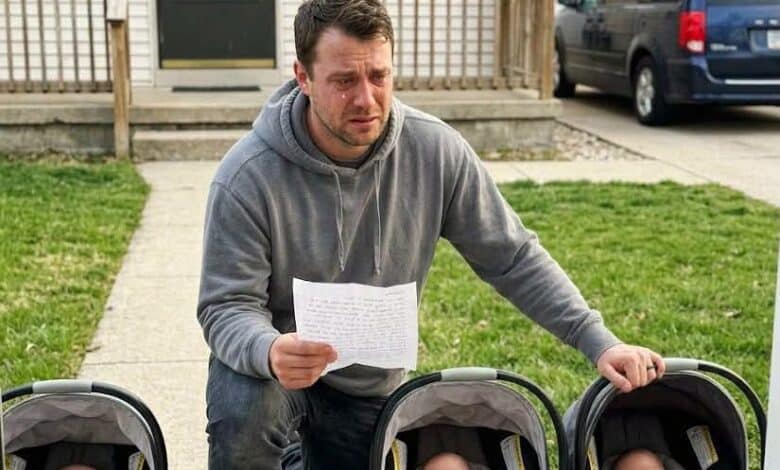
I was twenty-seven again, standing outside my tiny apartment above the hardware store with three six-month-old babies in car seats at my feet.
I could smell formula.
Dust.
Cold hallway air.
I could feel the panic of knowing I had $312 in my bank account and absolutely no idea what to do with three infants whose mother had died eleven days earlier.
On the back of that receipt, my brother had written:
I’m sorry, Noah. I can’t do this.
For twenty-two years, I thought that was all he had left.
It wasn’t.
The girls had found another letter hidden beneath the stiff bottom of the original diaper bag.
June explained later that they discovered it while packing for college.
I had pulled the battered old bag from storage and laughed when Ava asked why I still had it.
“Because I paid too much replacing everything that went inside it,” I’d joked.
After I left the room, Claire noticed the bottom panel had come loose.
Underneath was an envelope.
My name was written across the front.
They opened it.
They were eighteen.
Then they made a decision I still wasn’t sure whether to admire or be furious about.
They told me nothing.
The line June had read from the stage appeared near the bottom.
If they ever call you Dad, don’t correct them for my sake.
That was the sentence that had dropped me to my knees.
Now I forced myself to begin at the top.
My brother’s letter wasn’t beautiful.
It wasn’t noble.
And it did not contain any explanation powerful enough to excuse what he had done.
It was painfully honest.
He wrote that after his wife died, every cry from the babies frightened him.
One would start, then the others would follow, and he would stand there frozen because he had no idea which daughter to pick up first.
He hadn’t slept.
He barely ate.
He said grief made the walls feel smaller every hour.
Then I reached the sentence that made anger rise hot beneath my ribs.
You’ll know what to do because you always stay when things get hard.
I stopped reading.
Ava saw my expression.
“That made us angry too,” she said quietly.
I looked at her.
“He knew.”
June answered.
“Yes.”
For years, I had imagined my brother breaking under grief and leaving the girls with the nearest person he thought might help.
But the letter revealed something harder.
He had chosen me because he knew exactly what kind of person I was.
He knew I wouldn’t walk away after he did.
He had counted on that.
I continued.
He wrote about watching me hold the girls before their mother died.
Ava had stopped crying when I bounced her against my shoulder.
Claire had grabbed my shirt and refused to let go.
June had simply stared at me with those enormous serious eyes she somehow still had twenty-two years later.
Then came the sentence I was least prepared for.
I know what this will cost you.
My thumb pressed against the page.
He knew I was single.
He knew where I lived.
He knew what I earned.
He knew my life had barely started.
And he left three babies on my doorstep anyway.
The next lines were worse.
You’re going to lose things because of me. I know that. I don’t have the right to ask you for this, so I’m not asking. I already know what you’re going to do.
I lowered the letter.
“He knew,” I said again.
This time the words sounded different.
Older.
Heavier.
The kind of anger that had waited twenty-two years to learn where it belonged.
“Why didn’t you show me?”
Claire looked at her sisters.
Ava answered.
“Because you would’ve made it about him.”
I frowned.
“You would’ve wondered whether he was depressed. Whether grief broke him. Whether we should forgive him. Whether you had judged him too harshly.”
“That sounds like me?”
All three answered at once.
“Yes.”
Despite everything, I laughed.
June crouched in front of me.
“We didn’t want his letter deciding what you meant to us.”
She tapped the paper gently.
“He wrote that if we called you Dad, you shouldn’t correct us for his sake.”
She shook her head.
“I hated that.”
“Why?”
“Because it sounded like he was giving permission.”
That silenced me.
Claire sat beside me.
“So we waited.”
“For graduation?”
“For ourselves,” June said.
At eighteen, they told me, they were still children in many ways.
They loved me.
They called me Dad.
But they wanted to know that someday, when they explained what I meant to them, it wasn’t because they were angry at the man who abandoned them.
They wanted to understand adulthood first.
Responsibility.
Failure.
Staying.
So through four years of college, they watched.
Ava remembered calling me after failing an exam and hearing me ask what happened before I ever asked what grade she got.
Claire remembered coming home after her first serious breakup and discovering I had filled the refrigerator with the same ridiculous comfort foods she loved as a teenager.
June remembered hanging up on me during an argument sophomore year.
I remembered that too.
I had been furious.
But I still texted:
Call when you get there.
She called at 1:17 a.m.
I answered before the second ring.
“You never stopped being our dad when we were difficult,” June said. “So we didn’t want to call you Dad only because we were grateful.”
I lowered my face.
That sentence defeated me more completely than anything in my brother’s letter.
When I finally looked down again, I saw three new lines written beneath his final words.
Three different handwritings.
Ava’s tilted forward impatiently.
Claire’s was neat.
June’s almost looked printed.
He didn’t choose who our dad was.
We did.
I covered my mouth.
Claire leaned her head against my shoulder.
Ava tightened her hand around my arm.
June stayed in front of me.
Then she said one word.
“Dad.”
Not Uncle Noah.
Not Noah.
Dad.
“Come back up there with us.”
I immediately shook my head.
“No.”
Ava groaned.
Claire rolled her eyes.
June closed her eyes like she was praying for patience.
“That’s your graduation,” I protested.
Ava pointed at me.
“You see? This is exactly why we had to trap you in a stadium.”
That got another broken laugh out of me.
Then June reached down and pulled me up.
For twenty-two years, I had been the one lifting them.
From scraped knees.
Bedroom floors after heartbreak.
Bad grades.
Fevers.
Failures.
Now one of my daughters was pulling me to my feet.
So I let her.
Onstage, I stood between the three of them.
I whispered, “Your mother would be proud.”
All three faces softened.
I had never wanted loving me to mean forgetting her.
Ava took my hand.
“We know.”
Then Claire looked at the letter.
“And you know something now too.”
“What?”
“You don’t have to protect him from us.”
For years, whenever they asked about their biological father, I had used words like scared.
Grieving.
Overwhelmed.
Young.
I gave them every possible explanation because I never wanted them to believe he left because they were impossible to love.
June seemed to understand.
“You gave us the truth without making us carry your anger,” she said. “That was enough.”
I looked at the page.
“I was angry.”
“We know.”
“I still am.”
Ava shrugged.
“You’re allowed to be.”
That may have been the greatest gift they gave me that day.
Permission to stop being careful for one moment.
Later, Claire noticed my old camera hanging from my wrist.
“You have thousands of pictures of us,” she said. “How many are you in?”
I didn’t answer.
She handed the camera to a stranger and pushed me between them.
I tried to move to the side.
Three hands stopped me.
“Middle,” Claire ordered.
“Stay,” June said.
So I stayed.
The first photograph was terrible because Ava was crying.
The second was worse because I was.
The third caught all four of us laughing.
It became my favorite picture.
A few weeks later, Claire had it printed.
On the back, each girl wrote one sentence.
Ava: Thanks for staying.
Claire: Thanks for letting us become ourselves.
June: Stop correcting people when they call you our father.
I laughed so hard I had to sit down.
Then June set the picture upright.
Claire grabbed the camera.
Ava complained her hair looked awful.
The timer started blinking.
This time nobody pushed me to the edge.
Ava leaned against one shoulder.
June took the other.
Claire hooked her arm through mine.
And just before the shutter clicked, all three of them shouted the same word.
“Dad!”
For twenty-two years, I thought I had given up my life to raise three abandoned girls.
Standing there between the women they had become, I finally understood.
I hadn’t given my life away.
They had become it.