I came home three hours early and found my sick mother cooking over a hot stove while trying to care for my two-year-old twins. One child was shaking in her arms. The other was clinging to her leg. In the living room, my husband and his mother sat comfortably, treating her like a servant. I was ready to leave quietly with my children. Then I saw the bruises on my mother’s face and arms. That was when I opened the gates to the mansion across the street—the one they never knew I owned.

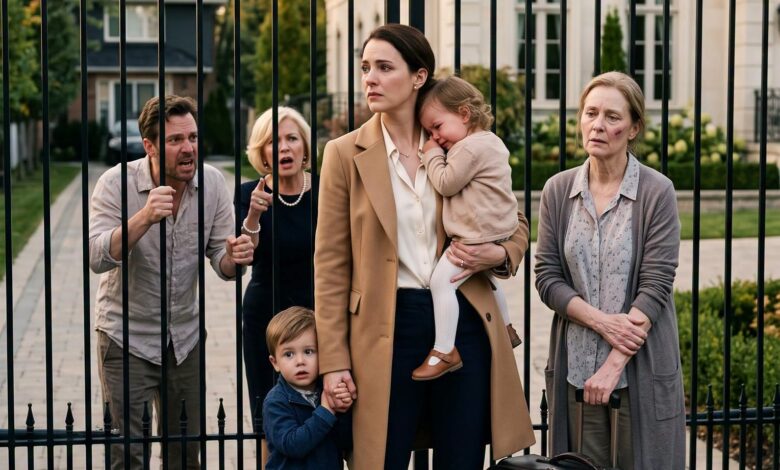
I came home three hours early and found my sick mother cooking dinner while holding one of my crying toddlers.
My other child was wrapped around her leg.
My husband was drinking beer in the living room.
His mother was giving orders from the sofa.
“Margaret can rest when dinner is finished,” Vivian snapped.
Then my mother turned toward me, and I saw the bruises.
One darkened her cheek. Others circled her wrist.
Margaret had severe rheumatoid arthritis. Some mornings, simply closing her fingers hurt.
Yet while I traveled for work, Vivian had apparently decided my mother should cook, clean, wash Ryan’s clothes, and care for two-year-old twins simultaneously.
“Who hurt you?”
Margaret lowered her sleeve.
“I fell.”
From the living room, Ryan laughed.
“She still hasn’t finished my laundry.”
Something inside me went cold.
I took Emma from Margaret and lifted Oliver.
“We’re leaving.”
Vivian stormed into the kitchen.
“She hasn’t finished dinner.”
Ryan followed.
“Claire, calm down.”
Then he moved toward the door as though he might stop us.
I looked directly at him.
“Move.”
Perhaps he heard something unfamiliar in my voice, because he did.
I grabbed Margaret’s suitcase and walked outside with my mother and children.
Then I crossed the street.
Ryan followed barefoot.
“Where are you going?”
Toward the largest mansion in the neighborhood.
The house Ryan had spent three years mocking because its mysterious owner supposedly had “more money than taste.”
I pressed my thumb against the scanner.
The gates opened.
Ryan stopped.
“How do you have access?”
“Because I own it.”
His face went blank.
“I bought it three years ago.”
“You never told me.”
“No.”
“Why?”
I looked at my bruised mother.
“Apparently I had good instincts.”
Inside, Margaret collapsed onto a bench.
“I don’t want to ruin your marriage.”
“You aren’t.”
I crouched in front of her.
“Tell me what happened.”
The truth came slowly.
Vivian had grabbed her hard enough to leave marks after Emma spilled juice. Ryan had seen it.
Instead of defending Margaret, he’d warned her not to upset me during my trip.
Then I asked about her cheek.
“Did Ryan touch you?”
“No.”
Too fast.
“Mom.”
Her eyes filled.
“He pushed me once.”
Two nights earlier, Margaret had told him she wasn’t his servant.
Ryan grabbed her shoulder during the argument. She stumbled into a cabinet.
I wanted to cross the street.
I didn’t.
Anger wanted confrontation.
My mother needed something else.
Medical care.
Documentation.
Safety.
So I called for help.
Then Ryan’s messages began.
Open the gate.
You can’t take my children.
Stop being dramatic.
Then:
You’ll regret this.
When he and Vivian appeared at the gate, I spoke through the intercom.
“The children are safe. Margaret is receiving care. Do not come onto this property.”
Vivian screamed that the mansion belonged to the family.
“No. It doesn’t.”
Ryan demanded an explanation.
I told him the property had been acquired through arrangements separate from the lifestyle he’d spent years treating as his personal achievement.
His first question wasn’t about Margaret.
It wasn’t about the twins.
“How much money are you hiding?”
I switched off the intercom.
That night, Margaret told me something stranger.
She had known Vivian before Ryan and I ever met.
Before she could explain, the front security system alerted me to an authorized visitor.
Thomas Hale stood outside.
My late father’s attorney.
He had represented Dad for decades.
When he saw Margaret’s bruises, his face changed.
“Oh, Margaret.”
Then he opened his briefcase.
Inside was an envelope in my father’s handwriting.
My name was across the front.
Beneath it:
If Margaret is ever in danger, give Claire this.
The letter did not contain a magical explanation of everything.
It contained warnings.
Names.
Copies of old records.
Questions Dad had never completely answered.
One name appeared repeatedly.
Vivian Bennett.
Years before I married Ryan, Vivian’s first husband, Samuel Bennett, had worked with my father.
Money disappeared.
Relationships collapsed.
Samuel vanished.
Vivian blamed him.
My father apparently never believed the story was that simple.
Thomas showed me an old photograph.
Dad.
Margaret.
Vivian.
Samuel.
Four people smiling as though none of them knew what was coming.
“You knew her?” I asked Margaret.
“Yes.”
“And she recognized you when Ryan introduced us?”
“Yes.”
My stomach turned.
“She pretended she didn’t.”
Margaret nodded.
The next discoveries were less cinematic than they were devastating.
Company archives.
Old correspondence.
Property records.
Financial documents.
Investigators and attorneys spent months separating fact from suspicion.
But one fact became difficult to ignore.
Ryan’s entrance into my life had not been entirely accidental.
Years earlier, Vivian had helped steer him toward professional circles where I worked.
Whether Ryan understood her full motive from the beginning remained disputed.
What was clear was that Vivian had remained intensely interested in my father’s estate.
Then we found the reason.
My father had preserved evidence suggesting financial irregularities connected to Vivian during Samuel’s employment.
Samuel’s signatures appeared on questionable transactions.
But other records suggested he might not have been the person benefiting from them.
My father had suspected fabrication.
And Samuel had disappeared before everything could be resolved.
Then Ryan contacted me.
He had found something among Vivian’s possessions.
A black metal case.
Inside were old genetic reports and a statement signed by Samuel.
Ryan sounded different.
Not angry.
Shaken.
“My mother lied to me.”
The genetic report concerned something Vivian had apparently used for years as leverage.
She had once claimed Ryan was my father’s biological child following a brief mistake during a separation in my parents’ marriage.
Testing later contradicted that claim.
Samuel was Ryan’s biological father.
Vivian had nevertheless allowed Ryan to grow up believing another story—that my father had rejected him and withheld a fortune that should have been his.
Suddenly Ryan’s obsession with my family’s money looked different.
Not excusable.
But different.
He had been raised inside a grievance built partly on a lie.
Samuel’s statement added another shock.
He hadn’t died.
He had left voluntarily after realizing his name had become entangled in transactions he said Vivian manipulated.
Eventually, through investigators rather than some reckless private confrontation, Samuel was located.
He was older.
Remarried.
A father again.
A grandfather.
Ryan met him.
The reunion wasn’t beautiful.
Ryan asked the obvious question.
“If you knew she was lying to me, why did you leave me with her?”
Samuel had no good answer.
Fear explained abandonment.
It didn’t erase it.
He did, however, provide records he’d preserved.
Those records, combined with my father’s files and other evidence, became part of a much larger investigation into the old financial activity.
Vivian eventually faced consequences for conduct investigators could actually establish.
Margaret’s injuries were handled separately.
Ryan cooperated.
That mattered.
It did not absolve him.
He had watched his mother mistreat mine.
He had threatened Margaret with losing access to the twins.
He had put his hands on her.
No revelation about his childhood transformed those choices into someone else’s responsibility.
Months later, Thomas called with something unrelated to Vivian.
My father had quietly repurchased the farmland Margaret once sold to pay for my education.
He had placed it where it would eventually return to her.
When Margaret saw the deed, she cried.
“I thought it was gone forever.”
“You sold it because of me.”
She touched my face.
“And I’d do it again.”
“I wish you hadn’t needed to.”
Then she gave me a strange look.
“There are things mothers do.”
I didn’t understand until another old photograph surfaced.
A woman stood beside Margaret.
They looked almost identical.
She was holding a baby.
Me.
“Who is she?”
Margaret sat down.
“My sister. Miriam.”
The room seemed to shrink.
Then Margaret told me the truth.
She had raised me.
Loved me.
Stayed awake when I was sick.
Worked two jobs.
Sold land for my education.
But she had not given birth to me.
Miriam had.
She’d been nineteen and overwhelmed.
My father later adopted me legally, and Margaret became my mother in every way that shaped my childhood.
But the secret still hurt.
I didn’t speak to her for two days.
Love didn’t cancel betrayal.
Betrayal didn’t cancel love.
Both existed.
Eventually I met Miriam in California.
She cried when she saw me.
I also met my biological father, Jonathan.
He didn’t rush toward me or demand a relationship.
He simply said, “I didn’t know.”
For some reason, his restraint made believing him easier.
A year after the afternoon I came home early, our lives looked nothing like they had before.
Margaret lived safely.
Her arthritis hadn’t disappeared, but her home was arranged around what helped rather than what others demanded from her.
The twins were thriving.
Ryan and I divorced.
That mattered too.
I refused to make reconciliation the prize for his cooperation or therapy.
He needed to change because what he’d done was wrong, not because good behavior might earn his wife back.
He found work.
Went to counseling.
Showed up consistently for Oliver and Emma.
And eventually apologized to Margaret without asking her to forgive him.
Months after the divorce was final, he asked whether I’d have coffee with him.
I said yes.
Coffee became occasional walks.
Then dinners.
Separate homes.
No financial dependence.
No promises.
When he once asked where we were headed, I answered honestly.
“I don’t know.”
For perhaps the first time in our relationship, he accepted uncertainty without trying to control it.
On Margaret’s birthday, we gathered at the restored farmhouse.
Miriam came.
Jonathan came.
Samuel came.
The configuration would have seemed impossible a year earlier.
Thomas arrived too.
“Please tell me you didn’t bring another envelope,” I said.
He smiled.
“One.”
I groaned.
It was my father’s final letter.
Most of it was personal.
But one passage stayed with me.
He wrote that family could not be reduced to blood, names, property, or obligation.
Those things could explain where someone came from.
They couldn’t decide who deserved access to another person’s future.
I looked across the field.
Margaret was laughing with Miriam.
Oliver was trying to launch a kite.
Emma had fallen asleep against Margaret.
Ryan stood nearby.
Not inside our family because he was entitled to be there.
Not excluded because punishment demanded it.
Simply present, responsible for what he had done and uncertain about what might come next.
That uncertainty no longer frightened me.
For years, I thought inheritance meant houses, land, trusts, companies, and whatever secrets dead people left in envelopes.
I was wrong.
The mansion across the street had given us somewhere safe to go.
The money had given me choices.
The documents had helped uncover pieces of the past.
But none of those things rebuilt us.
Truth did.
Boundaries did.
Accountability did.
And choice did.
Margaret was my mother whether or not we shared blood.
Miriam was part of my beginning without automatically being entitled to the rest of my life.
Samuel’s fear explained why he disappeared without excusing the son he abandoned.
Ryan’s childhood explained some of his wounds without erasing the wounds he caused.
And forgiveness, where it came at all, never meant pretending none of it happened.
That became the real inheritance my family left me:
Nobody is entitled to another person’s labor because they’re family.
Nobody owns another person’s forgiveness because they’re sorry.
Nobody deserves access because they share blood, history, marriage, or children.
Love isn’t ownership.
Love is something people keep choosing through what they do.
And home isn’t the biggest house you can afford.
It’s the place where the people inside it are finally allowed to feel safe.