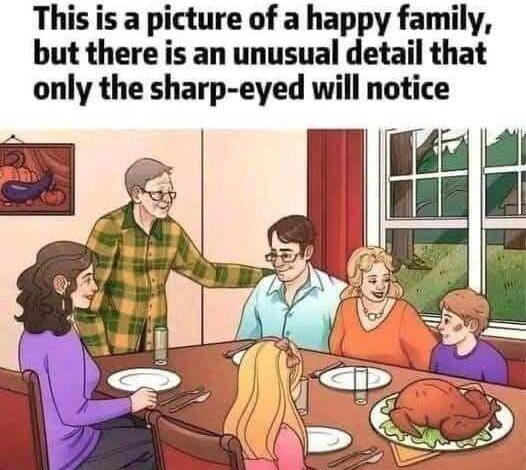
At first glance, the picture looks completely normal.
A family is gathered around a dining table, enjoying what appears to be a warm, cheerful meal together. The table is set, the room feels cozy, and a large turkey sits proudly in the center, suggesting a holiday dinner or special family gathering. Everyone seems focused on the moment, and nothing immediately appears unusual.
But that is exactly what makes this visual puzzle so clever.
The challenge is simple: find the hidden mistake in the image.
At first, most people begin by looking at the obvious details. They study the people around the table, the food, the plates, the chairs, and the elderly man standing nearby. Since he naturally draws attention, many viewers assume the mistake must involve him. Others focus on the turkey, wondering whether something about the meal is unusual.
But the answer is not found in the most obvious places.
The mistake is hidden in a much smaller detail.
That is why puzzles like this are so entertaining. They take an everyday scene and use our own assumptions against us. Because the image resembles something familiar, our brains quickly accept it as normal. We see a family dinner, and our minds fill in the rest automatically. Instead of carefully examining every object, we rely on the overall impression.
This is how small errors slip past us.
Visual puzzles often work by placing something strange in plain sight. The detail is visible, but because it is surrounded by ordinary objects, the brain ignores it. We are so busy understanding the full scene that we miss the one part that does not quite fit.
To solve this puzzle, you have to slow down.
Instead of focusing only on the faces, food, or table setting, look carefully at the smaller objects in the room. Pay attention to shapes, symmetry, and anything that should match but does not. In many observation puzzles, the hidden error is not dramatic. It is something slightly reversed, uneven, missing, or mismatched.
And in this case, the mistake is in the glasses.
Look closely.
The glasses are not the same shape on both sides. One side appears oval, while the other side is rectangular. At first, the difference is easy to overlook because the rest of the scene feels natural. But once you notice it, the mistake becomes impossible to ignore.
That is the beauty of this kind of puzzle.
The answer is not hidden behind anything. It is not buried in the background or disguised with complicated trickery. It is right there in front of you, waiting for your eyes to catch what your brain skipped over.
The mismatched glasses reveal how easily perception can be fooled. We often believe we are seeing everything clearly, but in reality, our minds are constantly filtering information. When something appears familiar, we tend to stop questioning it. That shortcut helps us move through daily life quickly, but it can also cause us to miss important details.
This puzzle is a fun reminder that observation is not just about looking.
It is about noticing.
Anyone can glance at a picture and understand the general scene. But spotting the mistake requires patience, focus, and curiosity. It requires asking, “What does not belong here?” instead of accepting the image too quickly.
If you found the error before reading the answer, you probably have a sharp eye for detail. If you missed it, you are definitely not alone. Many people stare at the image for several minutes and still fail to notice the mismatched glasses. That is part of what makes the puzzle so satisfying once the answer is revealed.
The moment you see it, everything changes.
What looked ordinary suddenly becomes strange.
The hidden mistake becomes obvious.
And you wonder how you missed it in the first place.
That “aha” moment is the reason visual puzzles continue to be so popular. They challenge our assumptions, test our attention, and give us a small but satisfying sense of discovery. They also remind us that sometimes the smallest details can completely change how we understand what we are seeing.
So, did you spot the mistake right away?
Or did the image fool you at first?
Either way, this puzzle proves that even the most ordinary-looking scenes can hide a surprise. Share it with friends or family and see how quickly they can find the error. Some will notice it immediately, while others may search everywhere except the right place.
And that is what makes it fun.
Sometimes the answer is not far away.
Sometimes it is right in front of us.
We just have to look a little closer.